Showing posts with label vintage. Show all posts

Thursday, September 02, 2021

Incredible Workmanship in the Reconstruction of a c. 1847 Mansion


For the last seven years there is an old stone mansion near us that has been in the local news and, currently, in the process of being renovated.  

Why was it in the local news?  Well, it started with the old stone mansion being torn down and sold and replaced with several new houses.  

It was such a shame as this old stone mansion was built in 1847 and had quite the history associated with it regarding the town and even one of the presidents.

In 2014 a group of teenagers heard about this old mansion being torn down and decided to do something about it.  They decided to protest the demolition of the mansion and used all their social media skills to help them with protesting it.  

They created signs and stood outside the mansion waving their signs for motorists passing by, created online petitions, and posted where ever they could online to educate the community about what was going on with the demolition of this mansion and why it shouldn't be demolished.

Their efforts quickly spread throughout the community and many residents joined in on the protest.

Well, as you can imagine, several weeks into the protest the current owner changed his mind and decided not to sell the property.  After that several groups concerned with historic preservation got involved with the end result being the residents approving utilizing funds to help preserve the mansion at their town meeting.

In 2016 after weeks of discussions the owner and town had an agreement on preserving the mansion and renovating it.

So, for the last few years we have been watching the meticulous and amazing process of renovating this historic property.  Every day we drive by it and marvel at the workmanship involved with creating this unbelievable mansion to it's original glory.  The stone and masonry work involved has been nothing short of astonishing.

The mansion was registered with the Massachusetts Historical Commission in 1999 and, according to the Friends of the Burnett-Garfield House, which worked with the owner and the town to preserve this old mansion, it is considered a historic property for many reasons.

 If you're interested in reading about why this house is considered historic please visit their Friends of the Burnett-Garfield House Facebook page.

Well, this past spring when my husband and I were driving by and marveling at the workmanship I decided to take some pictures as I found all of the renovations remarkable and thought you all might agree.

To put all of this in perspective you first need to see how the old mansion looked before they started renovating it.  

The property consisted of the old stone mansion, a carriage house, a chapel, and a summer house - all of which would be renovated.

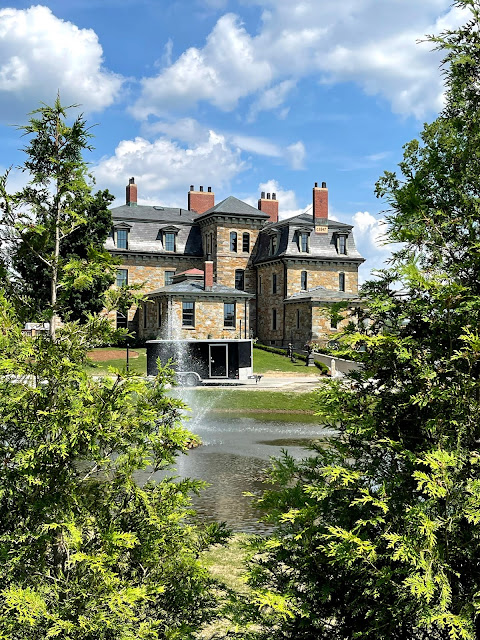
The picture at the beginning of this post shows the renovated chapel, mansion being renovated and part of the carriage house being renovated.


Photos courtesy of PM (Preservation Massachusetts) https://www.preservationmass.org/

Here's how the mansion looked before the renovation. 


Here's how it looks now while being renovated.


Here's how the chapel looked before the renovation. 


Here's how the chapel looks now after being renovated.

Photo courtesy of PM (Preservation Massachusetts) https://www.preservationmass.org/

Here's how the carriage house looked before the renovation.


Here's how the carriage house looks now as it's being renovated.


The incredible workmanship didn't just extend to the buildings.  It also extended to the beautiful landscaping all along and within the property.


I love all the roses and the garden just outside the chapel, which is shown in the pictures above.


Shrubs have been planted all along the property.


A watersprout was built in the pond.


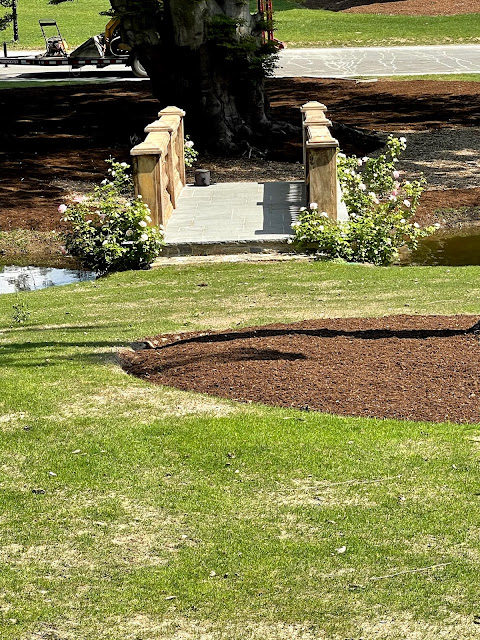
A beautiful gazebo, shown in the picture above and a bridge across the pond, shown in the photo below were added.


They also decided to renovate the corner along the street at the end of the road where the mansion was.  

Every day for the 33 years my husband and I have lived here the corner was nothing but a big mud pit filled with weeds and dirt. 

So, we were so happy when they started to renovate the corner.  I don't have a picture of how it used to look but the picture below is how it looks now.


We just love the way the corner has been finished and love seeing all the improvements to the old stone mansion. 

We can hardly wait to see what it looks like when it is done. For sure, it is a huge improvement to the town and this area.

We're hoping when it's finished that they will have tours for the residents of the town so we all can see the beautiful renovations that were done outside and inside this remarkable mansion.


Tuesday, July 19, 2016

Who Doesn't Love Paper Dolls? - Plus My Paper Dolls Pinterest Board


Image Courtesy of The Metropolitan Museum of Art
Ballerina and Bloomer Girls (Prima Donna) Paper Dolls
Publisher:Littauer and Boysen
Purveyor:Dennison Manufacturing Co. (New York, NY)
Date:1890–1905
Medium:Lithographs
Dimensions:each: 14 3/8 × 6 1/8 in. (36.5 × 15.5 cm)
Classification:Prints
Credit Line:Gift of D. Lorraine Yerkes, 1959
Accession Number:59.616.403a-g

I don't know if you're like me or not, but I like to reminisce about my childhood and the dolls, toys, or items that I loved to play with. In doing so I always say to myself, "Why didn't I save them?" I wish I had saved all of them. Some of them would be worth a fortune today.

Unfortunately, we moved a few times and old toys were discarded. Plus, what child thinks about saving something so they can have it 50 years down the road? None, that I know of and certainly not me. So, all my old toys, "Barbie" dolls, other dolls, and "paper dolls" were thrown away.

Today, with the advent of computerized doll makers and graphics "paper dolls" are making a comeback. You can create your own doll online or in your own graphics program and then print it out on your color printer on cardboard stock. Then just cut it out just like you did as a child. You're all set to play. How great is that?

In the paper, scrapbooking, stamping, and mixed media area there are so many gorgeous paper dolls being created and supplies generated to help you with that. In the mixed media and scrapbooking arena paper dolls are becoming an art form. Some of the creations are just astonishing. If you'd like to see some beautiful paper art dolls my" Paper Art Doll  Creations" Pinterest board is here.

Plus, with the advent of the computers, paper dolls went virtual.  You can create your own avatar dolls and virtual doll worlds. Over the years I've created a few avatars of my own, like my YoVille Linda shown below:


The Linda avatar on the left is the original YoVille (now known as YoWorld) avatar I created back in 2006.  The Linda on the right is the "Punk" version.  DollZ, which is what digital dolls are now known as, are extremely popular with numerous websites devoted to them.  You can create the dolls, create their clothing, their homes, their worlds, their friends, etc.  It's mindboggling.

I would have loved having everything that is available nowadays for paper doll creating when I was a child. I can remember sitting on the floor for hours with my scissors and painstakingly cutting out pictures from fashion magazines, which I used as paper dolls. Or, cutting out the "paper doll" pages from my mother's magazines. Cutting precise lines with the round tip children's scissors was a little difficult if not downright impossible. However, I did my best which is all anyone can ever really ask of you.

Then I would sit there for hours on end using my "paper dolls" and play acting. Sometimes we would have a "tea party." Other times we'd have a fashion show with everyone lined up. Then my older brother would come in an mess everything all up.

Ah, the joys of childhood and siblings. That's an article for another day. Back to the "paper dolls."

On my list of "To Do's" is to create my own "Victorian paper dolls" based upon my own doll designs. The problem is finding the "time" to do so. There are just so many things I want to try and so many things I want to do. My own "paper dolls" is among them.

Of course, thinking about "paper dolls" got me to wondering about their origin. If you're a reader of my Linda's Blog you know how much I love traditions and research.

The who, what, when, and where did mysteries. So, I thought I'd find out the history of paper dolls and the traditions surrounding them. When exactly did the "tradition" of playing with "paper dolls" begin? So, I did a little research.

It seems that paper dolls have a history that is as varied as the paper dolls themselves.  Paper dolls over the centuries have been created for various reasons and in various forms, some of which would not resemble the paper dolls we are accustomed to today.

According to Wikipedia.com, "Paper dolls have been around as long as there has been paper. Faces or other objects were applied to the paper and they were used during religious rituals and ceremonies in the Asian cultures many centuries ago. The Japanese used paper for Origami, artful paper folding, and dating back to 800 AD they folded paper figurines in the shape of Kimono. Balinese people made paper and leather into puppets since before the Christian Era. Other cultures around the world have had paper formations or paper art, including in Poland, where they were called Wy'cinanki. These early types of paper figures differ from typical paper dolls today, as no clothes were made to be used with the dolls."

It is said that Marco Polo may have brought the tradition of using "paper dolls" for puppet shows home with him. The "dolls" were printed on "papyrus" and then glued to sticks to be used as puppets for puppet shows.

Other historians refer to life-size cutouts of "nobility" used during stage performances as the start of paper dolls. Paper dolls first appeared in Paris in the 18th century, during the reign of Louis XV. On the other side of the English Channel during this time period, British printers printed "paper dolls" on flat sheets and added moral stories to go along with their creations.

According to some historians; Paper dolls began in the mid-1700s amongst the European fashion centers of Vienna, Berlin, London and Paris. Here they offered paper dolls with costumes.

For other historians, "paper dolls" began with "traditional" dolls and started in the late 18th century with French seamstresses and dressmakers as a selling tool. They would create 8" tall figures on cardboard with outfits and distribute these to their favorite customers.

In 1810 the first commercial "paper doll" called "Little Fanny" was created by S. & J. Fuller & Co. The "Little Fanny" 15-page book was expensive to buy so it was initially only popular amongst the wealthier families. In 1812 "Little Henry" was published in America by J. Belcher.

Beginning in the 1830s, celebrity paper dolls and "royalty" paper dolls began to appear. In Pioneer America, paper was a prized resource. If children were lucky enough to get paper dolls, they treasured them and saved them between the pages of a book or in a carefully guarded box.

The cost of paper later changed with the invention of mechanical grinding machines, which became a ready source for pulp paper. However it wasn't until 1838 when cheap paper made from wood pulp (i.e. newsprint) was widely used that "paper dolls" was made affordable to the average child. As paper became less expensive and more common, dolls were mass produced on inexpensive cardboard and became readily available to children.

In the 1800's in the United States "McLoughlin Brothers" quickly became one of the largest manufacturer of paper dolls. They printed them on engraved wooden blocks. McLoughlin Brothers was bought in 1920 and is now known as "Milton Bradley."

Until the development of color printing, paper dolls were colored by hand. In America, Civil War widows often earned money by embellishing the printed paper dolls.

Early printed doll clothes did not include tabs for dressing the dolls, as is common with paper dolls today. Instead, children painstakingly attached the clothes with tiny drops of sealing wax. They took great care when they attached their clothes to their dolls so they wouldn't tear the paper doll.

Early paper dolls were available in various stages of modesty. Some came with permanently printed clothes. Others came with multiple layers of clothes, while others had printed underwear and required only outerwear. By the 1800s most commercial paper doll clothes featured tabs.

Homemade paper wardrobes often rivaled the silken fashions worn by real ladies and gentlemen of their respective era. Some artists used bits of cloth, tissue paper and magazine pictures to craft beautiful ball gowns.

And, something near and dear to my heart - During the Victorian era, Godey's Lady's Book, was the first magazine to publish a paper doll in their November 1859 issue. This paper doll was printed in black and white with a coloring page of costumes.

At the turn of the century, department stores soon discovered that paper dolls were the ideal form of advertising. Specially designed dolls appeared in ladies magazines such as the Good Housekeeping, Ladies Home Journal, Ladies World, McCalls, Pictorial Review and Woman's Home Companion.

The most popular paper doll of the mid-20th century was probably Betsy McCall, created by Kay Morrissey. Since 1962, Barbie paper dolls have become the most popular among American children.

Today, "fine art paper dolls" and "paper art dolls" can be found on many websites and are sometimes drawn, painted or printed on paper. They even have their own Artist Trading Cards (ATCs) which can be traded or swapped.  And, if that isn't  modern enough you can arrange a playtime with your avatar and your friends in your own virtual community.

Collecting paper dolls is a wonderful hobby and one I would like to start. If you love historic fashions, ball gowns, personality paper dolls, modern characters, animals, cartoon characters, etc. there is a paper doll somewhere for you.

Paper dolls can be collected very inexpensively, are available for free downloads on many websites as printables and coloring pages, and are available for free in many magazines and ezines.

There are also hundreds of books for sale that include paper dolls of various types and historical periods to cut out and play with.  I have bought several of these with paper dolls dressed in  clothing from the Victorian Era just to see the beautiful dresses.


If all that isn't enough you can search for paper dolls on Pinterest and find thousands of paper doll examples to choose from here.   "Paper Doll" collecting is a wonderful way to relive childhood memories, and share something "new" with your children, grandchildren, and friends.

As mentioned, I played with paper dolls as a child and never stopped loving them. However, the paper art doll creations of today are nothing at all like the paper dolls I played with. They're amazing works of art.

I love the fact that so many of the scrapbooking and mixed media paper doll designers are willing to share their paper doll making making secrets by creating free tutorials, patterns and how-to's for all of us to use.  So, of course, I had to set up a Paper Doll Making Pinterest board to house all the wonderful links I've found.  If you love paper dolls, too, here's a few tutorials, video's and how-to's to help you with creating your own works of art.

Happy paper doll making.

If you'd like to know more about the history of paper dolls there is a wonderful "History of Paper Dolls" article by Judy M. Johnson on the OPDAG (Original Paper Doll Artists Guild) here.

I hope you enjoyed reading about the history of "paper dolls" .

Maybe I've encouraged you to become a "paper doll" collector, too. I know that I'm starting my own collection and, if I could just find some time, developing my own series of "Victorian paper dolls." So, who wants to swap paper dollies with me?

Saturday, May 07, 2016

Hitty Dolls - What's Not To Love!


If you've never heard of the Hitty book entitled "Her First Hundred Years" it's a children's book written by Rachael Field and Published in 1929. It won the Newbery Medal for excellence in American children's literature in 1930. It's a book about a lttle dolls adventures.

According to the Hitty Wikipedia pageThe book details Hitty's adventures as she becomes separated from Phoebe and travels from owner to owner over the course of a century. She ends up living in locations as far-flung as Boston, New Orleans, India, and the South Pacific. At various times, she is lost deep under the sea and also under sofa cushions, abandoned in a hayloft, serves as part of a snake-charmer's act, and meets the famous writer Charles Dickens, before finally ending up in an antique shop in New York City among other, fancier dolls of porcelain and wax. There Hitty is purchased and taken to her new owner's summer home in Maine, which turns out to be the original Preble residence where she first lived.

If you would like to read her book there is a .pdf of the words and chapters here.


If you would like to see all of the illustrations by Dorothy Lathrop for Rachael Fields book they are here.

Online Collections (The Strong) / CC BY-NC-ND 4.0

The Hitty Doll c. 1930, shown in the picture above, is from The Strong National Museum of Play website.

Credits: doll ca. 1930, Material wood | paint, Origin USA, Object ID 110.10782, Credit Line Gift of the family of Patricia M. Morse.

According to her description: The Hitty doll is the central character in Rachel Field's 1929 "Hitty: Her First Hundred Years," a children's book that received the Newbery Award. Field garnered inspiration for her story from a wooden doll she saw seated in the window of a New York City antique shop. In the story, the doll receives the name of Mehitabel by her first owner, Phoebe Preble. The story presents the doll's point of view and recounts how Phoebe shortened her name to Hitty. Hitty describes 100 years of adventures that began in Maine and included travels to New Orleans and Bombay, India. She recounts meeting Charles Dickens and John Greenleaf Whittier and she records that she had been lost, stolen, borrowed, exhibited, sold at auction, and abused by fire, water, and neglect. Through her many trials, she remains calm and stoic, and ever ready for her next adventure. The book inspired many whittlers to fashion Hitty dolls of mountain ashwood as gifts for little girls who enjoyed the doll's story.

Sounds like an amazing doll and story - doesn't it?


The original Hitty doll resides in the Stockbridge Library, Stockbridge, MA.  They produced a wonderful .pdf brochure The Stockbridge Library presents: “All Aboard” with Hitty! A doll, a book, a conference June 10-12, 2011 here.  I hope you get a chance to read it.  That would have been a fun conference - don't you think?


If you'd like more information on Hitty, the Hitty doll, and the modern day Hitty's please click here for the Practical Hitty website.

Image Courtesy of The Paris Review

The Paris Review ran a delightful article in the Our Daily Correspondent section entitled "Hitty, Her Second Hundred Years" by Sadie Stein about the Northeast Harbor Library and the book Hitty, Her First Hundred Years.  If you'd like to read her article please click here.

There's a wonderful post entitled "Incredible Vintage Wooden 1950's Hitty Doll 
with Accessories and Tasha Tudor Letters" on Maida Today by Dixie Redmond about the 1950 wooden Hitty doll at Lucy's Doll House here.  It's a wonderful post and I hope you get a chance to read it.

Image Courtesy of The Great Cranberry Island Historical Society

The Great Cranberry Island Historical Society has a Hitty's Home website to educate the public, especially children, on the rich history of Cranberry Island and their with author Rachel Field here.


Hitty dolls have become very popular amongst doll artists and your girls alike.  Gail Wilson is an amazing doll maker who specializes in reproduction antique dolls on her Gail Wilson Designs website.  The Hitty Series includes information on her Finished Hitty dolls, doll kits so you can make one of your own, Hitty doll clothes, clothes kits, patterns, accessories, Hitty house, information about Hitty, Hitty books & book clubs, Hitty Photo Gallery, and Hitty supplies.   If you love Hitty and would like to make a Hitty doll of your own you should visit Gail Wilson's website.

The Julie Old Crow website has a tutorial showing how to make a Hitty doll cradle quilt here.  She also has a Hitty dress pattern for sale on her Julie Old Crow Etsy shop here.

Tons of information on Hitty can be found on the Hittygirls website here.  Free patterns for Hitty Clothes is here.  Hitty's timeline is here.

I just love the Hitty dolls and I'm looking forward to making one some day. They're small, they're adorable, and they have exciting adventures. What's not to love!

Friday, May 06, 2016

For The Love Of Rococo Dolls - You Might Become Speechless, Too!

Image Courtesy of Carmel Doll Shop

I absolutely love Rococo fashions and have always wanted to make a Rococo fashion doll of my own.

Well, while doing some research on other fashion dolls I could hardly believe my eyes when I landed on the page for the unbelievable 18th Century Fashion Doll From Eugene Barrois c. 1790, shown in the picture above, from the Carmel Doll Shop website.  She was just stunning.  Just look at that amazing dress! And, that unbelievable hair.  I just LOVE her.

Please click here for more information on this beautiful doll.

Image Courtesy of Carmel Doll Shop

No sooner had I landed on the Carmel Doll Shop page for the doll at the beginning of this post when I saw the 18th Century Fashion Doll From Eugene Barrois, shown in the picture above, from the Carmel Doll Shop website.  She was every bit as stunning as the first one.  Just look at that amazing dress! And, that unbelievable hair.  Just stunning, too.

Please click here for more information on this beautiful doll.

Image Courtesy of Carmel Doll Shop

Seeing two astonishing Rococo fashion dolls is certainly a delight. What do you say when you see a third astonishing fashion doll like the 18th Century Fashion Doll From François Gaultier c. 1790, shown in the picture above, from the Carmel Doll Shop website.  Maybe you become speechless.

Please click here for more information on this beautiful doll.

Thursday, May 05, 2016

17th, 18th, and 19th Century Wooden Dolls


Online Collections (The Strong) / CC BY-NC-ND 4.0

I can't help falling in love with the beauty of the Queen Anne Doll, shown in the picture above, from The Strong National Museum of Play.  She is an exceptional wooden doll circa 1750-1800.

Credits: Queen Anne Doll, 1750-1800, Material wood, Origin England, Style Queen Anne, Object ID 79.451

I would love to see this doll.

Online Collections (The Strong) / CC BY-NC-ND 4.0

The unbelievable Earliest Queen Anne Doll c. 1690, is also from the Strong National Museum of Play.   How amazing is she?  Just incredible.

Credits: Doll ca. 1690, Material wood, Origin England, Style Queen Anne, Object ID 73.1447

According to their description: A simple, jointed body and carved face decorated with stylized eyebrows and brightly rouged cheeks characterize this "Queen Anne" style doll made in around 1700. Manufacture of these wooden dolls originally predated their namesake, Queen Anne, who reigned only from 1702 to 1714. English woodcarvers and craftsmen began making these dolls in the 1600s, and the craft continued through the 1840s. Affordable only to affluent families, the vast majority of Queen Anne dolls were owned by women, who dressed them in the fashions of the time. Because the clothing obscured the plain wooden bodies, carvers focused their artistic attention on the faces. The dolls' painted, almond-shaped eyes, though distinctly conventionalized, changed to glass or porcelain in later years, and limbs came to be made of fabric or leather. Dolls made prior to the mid-19th century are scarce: some reports note that fewer than thirty seventeenth-century Queen Anne dolls have survived.

Only thirty 17th century Queen Anne dolls have survived.  What a shame.

Online Collections (The Strong) / CC BY-NC-ND 4.0

The beautiful Queen Anne doll, shown in the picture above, is also from the Strong National Museum of Play.   How beautiful is she?

Credits: Early Queen Anne doll 1700-1799, Material wood, Origin England, Object ID 75.3093

My understanding was that various types of wooden dolls were being made from 1300 on. Prior to this ancient figures or dolls were made from bone, ivory, clay, leather, and carved from wood.

Wooden French dolls date from 1300 on. Some of the earliest English and German handmade wooden dolls date from 1600 on. William and Mary English wooden dolls date from 1680 - 1720. Queen Anne English Wooden dolls date from 1700 - 1750.German wooden dolls date from the 1700's.

Many wooden dolls from the 18th century on have been family treasures for years and passed down through families from generation to generation.

Supposedly there is a Marie Antoinette wooden doll in a museum in Salisbury, England that still has her entire ensemble, which was made by Marie Antoinette while she was in prison awaiting her execution in 1793.  I would LOVE to see this doll and her wardrobe.


The following is according to the 200 Years of Dolls: Identification and Price Guide By Dawn HerlocherAuthentic antique wooden dolls were typically manufactured in England sometime between the late 1600s and the early 1800s. (However, a large number of antique wooden dolls were manufactured in Germany during the 19th century as well). The majority of antique wooden dolls are generally female, however, a small number of wooden male dolls were manufactured during this period as well. Antique wooden dolls typically come with traditional folk art-style clothing and/or accessories, and usually feature glass eyes and facial expressions.

I decided I wanted to see more of the gorgeous 17th century, 18th century, and 19th century wooden dolls - especially the Queen Anne's. Here's what I found:

 Image Courtesy  National Gallery of Art,Washington.

The Wooden Dollshown in the illustration above, is from the Index of American Design at the National Gallery of Art in Washington.

Credits: Wooden Doll c. 1936, Iverson, Jane, American, 1910 - 1997 watercolor, graphite, gouache, and pen and ink on paper, overall: 34.6 x 27.2 cm (13 5/8 x 10 11/16 in.) Original IAD Object: 12 1/4" high, Index of American Design 1943.8.15570

 Image Courtesy  National Gallery of Art,Washington.

The Wooden Jointed Dollshown in the illustration above, is from the Index of American Design at the National Gallery of Art in Washington.

Credits: Wooden Jointed Doll c. 1936, Iverson, Jane, American, 1910 - 1997, watercolor, graphite, gouache, and pen and ink on paper, overall: 35.4 x 27.8 cm (13 15/16 x 10 15/16 in.) Original IAD, Object: 12" long, Index of American Design 1943.8.8144

A Doll c. 1790 was on the Historic New England Museum website here.

There was another Doll c. 1750 - 1800 on the Historic New England Museum website here.

I found two old wooden dolls in the collections of the Metropolitan Museum Of Art website.  The first Doll c. 1800 - 1815 was here.  The second Doll c. 1800 - 1815 was here.

The History.org website of the Colonial Williamsburg Foundation had a Wooden Doll, c. 1770–1775 here.

I found 3 beautiful wooden dolls in the collection of the Museum of Fine Arts, Boston.  A beautiful 18th Century Doll in  a red damask dress was here.  Another beautiful 18th Century Doll in a yellow taffeta dress was here. An amazing male Doll c. 1730 - 1740 in a blue satin waistcoat and breeches was here.

I thought I might find more example of Queen Anne type dolls in some of the museums in England. Here's what I found:

Images Courtesy of Hampshire Cultural Trust

The WOODEN DOLL, UNKNOWN ENGLISH MAKER, C. 1740–50, shown in the pictures above, are from the Hampshire Cultural Trust website.

According to her description; This particularly fine and well-preserved doll was donated to the Curtis Museum, Alton in 1949.... She is certainly an example of the so-called ‘Queen Anne’ dolls, but these were made throughout the late 17th and 18th century and not just in the reign of Queen Anne. English doll makers of this period were renowned for their fine and delicate work, although most remain anonymous. By the end of the 18th century, the quality of work in England had deteriorated, due to competition from cheaper wooden dolls made in Germany.

Also: The doll’s detailed and complete set of clothing reveals the work of either a very accomplished amateur (possibly a lady from a wealthy family indulging her passion for needlework) or that of a professional dressmaker showing off the latest fashions on her ‘pandora’ or fashion doll. What is certain is that the doll has not been played with much, if at all, by a child. It would have been very much a case of ‘Look, but don’t touch!’. Nevertheless, she has a broken finger.

For more information on this doll please click here.

There were five exceptional wooden dolls on the  Victoria and Albert (V&A) Museum, London.  A  gorgeous Doll c. 1740 - 1750 in a gold dress was here.  An amazing Fashion Doll With Accessories c. 1755 - 1760 in a gold embroidered dress was here.  Doll  c. 1770 - 1775 in a red dress was here.  An incredible couple of wooden dolls, one known as Lord Clapham c. 1690-1700 was here.  His spouse, Lady Chapman c. 1690-1700 was here.  These dolls were named 'Lord and Lady' of the family home in Clapham, London by their owners, the Cockerell family.

An exquisite doll known as The Old Pretender c. 1680 was here.  According to the V&A: The Old Pretender is one of the oldest dolls in the museum's collection. It was carved from wood and covered with gesso (a mixture of plaster and glue) before being painted. The doll is fashionably dressed with a wig made of human hair and beauty spots painted on the face. It is associated with the court of King James VII (of Scotland) and II (of England and Wales) at the palace of Holyroodhouse in Edinburgh. It is said to have been given to a family of loyal supporters by James II's son James Edward (acknowledged James VII in Scotland but not James III in England and Wales who was subsequently known as 'The Old Pretender').

Image Courtesy of HistoryTube.org Jamestown-Yorktown Foundation 

The  large wooden doll named Miss Chalkley, shown in the picture above, was pictured in an article entitled “Miss Chalkley,”  A Georgian Wooden Doll, Acquired for Yorktown Victory Center By David B. Voelkel, Curator on the HistoryTube.org Jamestown-Yorktown  Foundation website.

According to the article: A large wooden doll recently added to the Jamestown-Yorktown Foundation collection was made by an unknown English toymaker around the time of the American Revolution.

Also, according to the article: Though the American colonies broke with Great Britain, the trade links between consumers and suppliers were quickly re-established following the decisive American victory at Yorktown.  Luxury goods such as English wooden dolls continued to cross the Atlantic, as can be seen in many portraits of the 1780s.

For more information and to read this article please click here.

It seems there are quite a few 17th and 18th century wooden dolls in several of the museum collections.  So, I decided to see if there were any for sale on the various auction and doll shop websites.  Here's what I found:

Image Courtesy of Theriaults.com

The beautiful 18TH CENTURY WOODEN DOLL WITH DISTINCTIVE PROFILE, as shown in the picture above, was on the Theriaults.com website.

According to their description: 16" All-wooden doll with so-called "bulging" enamel eyes, dot-painted brows and lashes, closed mouth with extended center line, blush spots on cheeks, has artistically carved head having shaped cheek bones, distinctive chin, nicely shaped shortened nose with aquiline shape, elongated throat, modeled bosom, shapely waist, block-shaped lower torso, wooden arms with cloth attachments, dowel-jointed hips and knees, wearing lovely authentically styled costume of antique fabrics..... Comments: English, late 17th/early 18th century. Value Points: highly characterized doll with beautifully carved features, from the collection of the late Madeline Merrill, and featured in her book, The Art of Dolls 1700-1940,pp 4 & 71. Realized Price: $18,000.

Image Courtesy of Theriaults.com

The beautiful ENGLISH WOODEN DOLL OF THE MID-18TH CENTURY, as shown in the picture above, was on the Theriaults.com website.  How beautiful is she?

According to their description: 20" All-wooden doll with oval egg-shaped head, elongated throat, shapely torso, wooden arms with cloth shoulder attachments, carved claw-like fingers, block-shaped lower torso, simplistically carved arms and legs with dowel-jointing at hips and knees, enamel inset eyes, dot-painted lashes and thin brows, blush spots on cheeks, closed mouth with thin line between tiny lips, human hair wig, wearing authentically styled dress and undergarments of antique fabrics.... Comments: English,mid-18th century, the doll is being sold from the private estate collection of the late Madeline Merrill, and is shown in her book, The Art of Dolls 1700-1940,pp 6 & 71. 

Image Courtesy of Theriaults.com

The amazing FRENCH CARVED WOODEN COURT DOLLS IN ORIGINAL COSTUMES, as shown in the picture above, was on the Theriaults.com website.

According to their description: 14" Depicting persons of the 18th century French court, the pair of wooden dolls include a gentleman and lady, each with elaborate carved hair, facial features, highly characterized anatomical features, and wooden lower limbs with carved and painted shoes. The lady has pompadour style coiffure with four horizontal rows of curls at either side of the face, long looped curl at the back and a rolled coronet curl, strong facial features with painted details; the man has carved brown/grey hair with rolled curls at the sides and an extended carved ponytail behind. Each has hemp-wrapped upper torso and upper limbs, carved wooden lower limbs, and each is wearing its original silk and cotton transfer print costume with rich detail (see detail photographs),and the woman with tiniest pearl necklace and bracelets..... Comments: from a remarkable series of dolls created during the mid-late 18th century representing figures of the French court, and used by members of the aristocracy to story-tell innuendoes and social scandals of the day, being sold from the collection of the late Claude Detave, noted Parisian antiquarian and collector. Value Points: rare dolls, uniquely one-of-a-kind, in original condition and having original costumes. Realized Price: $11,000.

Image Courtesy of Theriaults.com

The gorgeous EARLY ENGLISH WOODEN DOLL WITH HIGHLY-CHARACTERIZED EXPRESSION AND ORIGINAL COSTUME c. mid-1700's, as shown in the picture above, was on the Theriaults.com website.

According to their description: 18" One-piece carved wooden head and torso, shapely bosom and waist, oval-shaped face with unusual puffy fullness to cheeks and well-defined chin tip, elongated throat, enamel inset eyes, painted upper and lower lashes, single-stroke brows with dot accents on upper edge, aquiline nose, closed mouth with full lips and piquant smile, original brunette human hair wig, cloth upper arms, wooden lower arms with individually-carved spatula-shaped hands, wooden legs with dowel-jointing at hips and knees.....Comments: English, mid-1700s, very rare early model with distinctive sculpting of facial shape...... Realized Price: $22,000

Image Courtesy of Carmel Doll Shop

The beautiful Georgian Wooden Doll, shown in the picture above, was on the Internet Archive Wayback Machine for the Carmel Doll Shop.

According to their description: Georgian wooden's have sometimes seen refreshing to their paint over the years, but we prefer to offer those that have remained just as the day they were made, like this tiny wooden lady. Standing 15-1/2" tall (overall) details include a turned wood head and torso with original paint, plus rosy cheeks, inset black glass pupil-less eyes and a wonderful mohair wig. The body features carved wooden legs that are jointed at the hips and knees, with forked hands (losses). Eighteenth century silk in various shades forms the basis of her elegant dress. A marvelous wooden that will help bring your early dollhouses or vignettes to life. Measures: 15" in height.

Image Courtesy of Carmel Doll Shop

The exquisite Georgian Wooden Doll c. 1780 - 1790, shown in the picture above, was from the Carmel Doll Shop website.

According to their description: 15 1/2" overall, is a Georgian Wooden in a desirable cabinet size - one who is small enough to reside in an early dollhouse or vignette, but large enough to play "mother" to your more child-like examples. Circa 1780-90, Lady Gwendolen's features include original paint in excellent condition that offers a glowing patina, painted eyes, rouged cheeks and what appears to be her original deep blonde wig. In addition, she is exquisitely costumed in period silk brocades, fine lace and silk ribbons - especially charming are her original leather "gloves" that she wears upon her simply carved wooden hands. A treasure, to be sure.

Image Courtesy of LiveAuctioneers.com

The unique Pair of Queen Anne Wooden Dolls, shown in the picture above, is from the Liveauctioneers.com website.  I just love their outfits.  Don't you?
According to their description: English, late 18th century, bedpost style all wood carved Queen Anne man and woman with pupil less brown glass eyes, painted features, mohair wigs, appropriately redressed in vintage brocade with metallic trim.  Size: tallest 28".

Nowadays many renowned art doll artists are making reproductions of wooden dolls from the 17th, 18th, and 19th century. Some are so good it would be hard to tell them from the real ones. I would love to make one of them but can't decide which century to choose. 17th, 18th, and 19th? Maybe I'll make one for each!