Showing posts with label Doll Histories. Show all posts

Sunday, February 02, 2020

For The Love Of Blythe!


I'm sure this won't be a surprise to any of you, but back in 2007 I fell in love with Blythe Dolls.  After all she is an adorable and irresistible doll.  At least she is as far as I'm concerned. 

If you haven't heard of Blythe dolls or know what she is she's an 11" fashion doll that is collected by thousands of young girls and woman all over the world. 

According to her Wikipedia page: Blythe is a fashion doll, about 28 cm (11 inch) tall, with an over-sized head and large eyes that change color with the pull of a string. It was created in 1972 and was initially only sold for one year in the United States by toy company Kenner (later purchased by Hasbro). In 2000 the photo book This is Blythe was published and in 2001 the Japanese toy company Takara began producing new editions of Blythe dolls. There is a network of hobbyists who customize the doll for resale and create clothing and shoes for Blythe. Enthusiasts share photographs of their work and other types of dolls on the Internet. 

So, when I came across two books of pictures of Blythe dolls back in 2007  I simply had to buy them.

I was so excited when my two Blythe books arrived  I just had to tear the package open. And, tear it - I did. I made quite a mess. I guess you could save my enthusiasm was a little over the top! Ya think?

In any event these are the two Blythe's books that I bought back in 2007 and which I have read many times. If you are a Blythe enthusiast I have to tell you they are fabulous.


Blythe Style is a delightful collection of photographs taken by Gina Garan of Blythe wearing 131 outfits created especially for her by some of fashion's best and brightest designers. This includes Gucci, Versace, Christian Dior, Dolce & Gabbana, John Galiano, Hysteric Glamour, Milk Fed, Paul Smith, Issey Miyake, Vienne Westwood, and many, many more.

It is a visually stunning presentation for all the Blythe lovers out there and definitely a book that the lovers of Blythe will adore. I have to say that Blythe did a fabulous job modeling all of these outfits. She may be a doll, but that doesn't make her any less of a fashion diva!

I absolutely love this book.


This is Blythe is a small book of photographs taken by Gina Garan of Blythe. In this book Gina has taken some of the most delightful and whimsical photographs of Blythe in various positions, locations, and with different outfits on.

She may be at the beach, gazing out over a lake, in front of the Eiffel Tower, catching her own reflection in a mirror, dressed as a nun, adorned with various hats, sitting on Santa's lap, with her head showing in a pile of oranges, using a video camera, playing with a Ouija board, in camouflage, etc. She is just about anywhere and all the pictures are just delightful.

Now you might be surprised by this but I haven't bought a Blythe doll yet.  It's on my bucket list of all doll related wishes and you can be sure that when I do I will be designing my own clothes for her.  Perhaps I'll create some Victorian dresses for her.  Now - why would that be?

Tuesday, February 27, 2018

I've Written A Lot of Doll Histories For My Linda's Blog and My Victorian Dolls Blog


Besides being a lover of Victorian dolls and genealogy I also love history - especially doll histories. Being a lover of doll histories prompted me to write all the doll history posts on my Victorian Dolls, Victorian Traditions, The Victorian Era and Me blog.

DOLL HISTORIES ON MY LINDA'S BLOG AND MY VICTORIAN DOLLS, VICTORIAN TRADITIONS, THE VICTORIAN ERA AND ME BLOG 


I thought if you were as interested in doll histories as I am you'd like an easier way to read all my doll history posts.  So, I created .PDF's for all of my posts.  In all there are 4 different .pdf's each with up to 50 pages.  If you would like to download my "Gotta Love Doll Histories Part 1 - Part 4 just click on the pictures or titles below:

Copyright © 2004-2023- All Rights Reserved - Written by By Linda Walsh

The Bangwell Putt Rag Doll
The Molly Brinkerhoff Doll 
The White House Doll
Apple Head Dolls
Penny Wooden or Peg Wooden Dolls 
Wishbone Dolls
Early American Wooden Dolls By Joel Ellis 
Tuck Comb Wooden Dolls
Grodnertal Tuck Comb Wooden Peddler Dolls 
Grodnertal Wooden Costume Dolls
Beautiful Peddler or Pedlar Dolls 
William F. Goodwin Patent Walking Doll 
Dolls From The Index of American Design at National Gallery Of Art
Shell Dolls 
Frozen Charlotte Dolls 

Copyright © 2004-2023- All Rights Reserved - Written by By Linda Walsh

Clay Pipe Dolls 
Roxanna Elizabeth McGee Cole's Dolls
Wooden Spoon Dolls and More 
Bartholomew's Babies 
Carved Nut Dolls 
Clothespin Dolls
Miss Columbia and the Columbian Rag Doll 
Pioneer & Prairie Dolls, Rag Dolls, Appalachian Dolls, Wagon Train Dolls, Table Cloth Dolls, Pillowcase Dolls, Handkerchief & Prayer Dolls, Folk Art Dolls 
Quaker Dolls 

Copyright © 2004-2023- All Rights Reserved - Written by By Linda Walsh

 Missionary Rag Babies 
China Head Dolls 
Babyland Rag Dolls With Painted Faces and Lithograph Faces
Wax Dolls, Montanari and Pierotti Dolls 
Polly Heckewelder Moravian Rag Dolls 
First Presbyterian Church Rag Dolls 
Izannah Walker Dolls
Papier-Mâché Dolls
Milliner's Models Dolls 
Boudoir Dolls 
17th, 18th and 19th Century Wardrobe or Trousseau Dolls
Topsy-Turvy Dolls - Two In One 


Copyright © 2004-2023- All Rights Reserved - Written by By Linda Walsh

The Maggie Bessie Cloth Doll
17th, 18th, and 19th Century Wooden Dolls
For The Love Of Rococo Dolls 
Hitty Dolls 
The Beautiful Collection of Fashion Dolls At The Strong National 
Museum of Play
How Wonderful! I Heard From A Descendant of Roxanna Cole - Hilarie Johnston
The French Doll Fashion Collection At The MET
The Innu Tea Doll

DOLL HISTORIES ON MY LINDA'S BLOG


Who Doesn't Love Paper Dolls?


I hope you enjoy all my posts.

For more information on all my free e-patterns, e-printables and e-books please CLICK HERE.

Please respect My Terms of Use:  All patterns, e-patterns, printables, e-printables, e-books, graphics, tutorials, how-to's, articles and other e-products © 2004-2023 Linda Walsh Originals-Designs by Linda Walsh. All rights reserved. Commercial selling or reselling by any means prohibited without the written consent of Linda Walsh.

Patterns, e-patterns, printables, e-printables, e-books, graphics, tutorials, how-to's, articles and other e-products are for personal use only. You may not modify, photocopy, download, upload, post, transmit, display, perform, publish, license, reprint, create derivative works from, mass duplicate, re-sell, digitize, and reproduce in any other form (print, digital or electric) or commercially apply, embed, share, Email, or redistribution in any other means. Use of any of the above is prohibited without the written permission of Linda Walsh.

However, you may link to my website(s)/blog(s) and the individual page(s)/blog post(s) (including 1 picture) but do not copy, reprint or duplicate my website(s)/blog(s) or individual page(s)/post(s ) without my permission.

Items made from Linda Walsh Originals E-Patterns are intended for personal use for fun or small scale personal and business profit as long as you credit us with the design. Large scale commercial use (i.e. mass production) of items made from Linda Walsh Originals E-Patterns are by permission only.

Please see my Terms and Conditions for additional information.

Copyright © 2004 - 2023 - All Rights Reserved - Written By Linda Walsh of Linda Walsh Originals and Linda's Blog. Linda is a doll maker and doll pattern designer.


Wednesday, March 08, 2017

Gotta Love Doll Histories Free E-Books - Part 1 - Part 4

Besides being a lover of Victorian dolls and genealogy I also love history - especially doll histories. Being a lover of doll histories prompted me to write all the doll history posts on my Victorian Dolls, Victorian Traditions, The Victorian Era and Me blog.

DOLL HISTORIES ON MY LINDA'S BLOG AND MY VICTORIAN DOLLS, VICTORIAN TRADITIONS, THE VICTORIAN ERA AND ME BLOG 


I thought if you were as interested in doll histories as I am you'd like an easier way to read all my dol history posts.  So, I created .PDF's for all of my posts.  In all there are 4 different .pdf's each with up to 50 pages.  If you would like to download my "Gotta Love Doll Histories Part 1 - Part 4 just click on the pictures or titles below:

Copyright © 2004-2017- All Rights Reserved - Written by By Linda Walsh

The Bangwell Putt Rag Doll
The Molly Brinkerhoff Doll 
The White House Doll
Apple Head Dolls
Penny Wooden or Peg Wooden Dolls 
Wishbone Dolls
Early American Wooden Dolls By Joel Ellis 
Tuck Comb Wooden Dolls
Grodnertal Tuck Comb Wooden Peddler Dolls 
Grodnertal Wooden Costume Dolls
Beautiful Peddler or Pedlar Dolls 
William F. Goodwin Patent Walking Doll 
Dolls From The Index of American Design at National Gallery Of Art
Shell Dolls 
Frozen Charlotte Dolls 

Copyright © 2004-2017- All Rights Reserved - Written by By Linda Walsh

Clay Pipe Dolls 
Roxanna Elizabeth McGee Cole's Dolls
Wooden Spoon Dolls and More 
Bartholomew's Babies 
Carved Nut Dolls 
Clothespin Dolls
Miss Columbia and the Columbian Rag Doll 
Pioneer & Prairie Dolls, Rag Dolls, Appalachian Dolls, Wagon Train Dolls, Table Cloth Dolls, Pillowcase Dolls, Handkerchief & Prayer Dolls, Folk Art Dolls 
Quaker Dolls 

Copyright © 2004-2017- All Rights Reserved - Written by By Linda Walsh

 Missionary Rag Babies 
China Head Dolls 
Babyland Rag Dolls With Painted Faces and Lithograph Faces
Wax Dolls, Montanari and Pierotti Dolls 
Polly Heckewelder Moravian Rag Dolls 
First Presbyterian Church Rag Dolls 
Izannah Walker Dolls
Papier-Mâché Dolls
Milliner's Models Dolls 
Boudoir Dolls 
17th, 18th and 19th Century Wardrobe or Trousseau Dolls
Topsy-Turvy Dolls - Two In One 


Copyright © 2004-2017- All Rights Reserved - Written by By Linda Walsh

The Maggie Bessie Cloth Doll
17th, 18th, and 19th Century Wooden Dolls
For The Love Of Rococo Dolls 
Hitty Dolls 
The Beautiful Collection of Fashion Dolls At The Strong National 
Museum of Play
How Wonderful! I Heard From A Descendant of Roxanna Cole - Hilarie Johnston
The French Doll Fashion Collection At The MET
The Innu Tea Doll
For more information on all my free e-patterns, e-printables and e-books please CLICK HERE.

Please respect My Terms of Use:  All patterns, e-patterns, printables, e-printables, e-books, graphics, tutorials, how-to's, articles and other e-products © 2004-2023 Linda Walsh Originals-Designs by Linda Walsh. All rights reserved. Commercial selling or reselling by any means prohibited without the written consent of Linda Walsh.

Patterns, e-patterns, printables, e-printables, e-books, graphics, tutorials, how-to's, articles and other e-products are for personal use only. You may not modify, photocopy, download, upload, post, transmit, display, perform, publish, license, reprint, create derivative works from, mass duplicate, re-sell, digitize, and reproduce in any other form (print, digital or electric) or commercially apply, embed, share, Email, or redistribution in any other means. Use of any of the above is prohibited without the written permission of Linda Walsh.

However, you may link to my website(s)/blog(s) and the individual page(s)/blog post(s) (including 1 picture) but do not copy, reprint or duplicate my website(s)/blog(s) or individual page(s)/post(s ) without my permission.

Items made from Linda Walsh Originals E-Patterns are intended for personal use for fun or small scale personal and business profit as long as you credit us with the design. Large scale commercial use (i.e. mass production) of items made from Linda Walsh Originals E-Patterns are by permission only.

Please see my Terms and Conditions for additional information.

Copyright © 2004 - 2023 - All Rights Reserved - Written By Linda Walsh of Linda Walsh Originals and Linda's Blog. Linda is a doll maker and doll pattern designer.

Sunday, September 04, 2016

How Wonderful! I Heard From A Descendant of Roxanna Cole - Hilarie Johnston

Conway, Arkansas Studio Portrait of 4 Generations

Back row left: Roxanna Cole - age 68
Back row center: Sarah Thurmond Hunt (Molly's Mother)
Back row right: Mary Love Harten (Sarah's Mother-In-Law)
Front row left: Molly Hunt Cole - age 44 (Roxanna's Daughter-In-Law)
Front row right: Sarah Harten- age 20 (Molly's Daughter) holding 1 Yr. Old Laura Harten

To my sheer delight in August 2016 I received a wonderful email from the great, great, great granddaughter of Roxanna Cole, Hilarie Johnston, asking me to contact her. She wanted to tell me that she had two of Roxanna's beautiful handmade dolls.

If you will recall back in April of 2016 I wrote a post entitled "Roxanna Elizabeth McGee Cole's Beautiful Family Of 19th Century Dolls" that contained all the information, or should I say lack of information, I could find on Roxanna Cole.


Image Courtesy National Gallery of Art, Washington.

My research on Roxanna Cole all started with my perusing the collection of doll illustrations from the Dolls From The Index of American Design at National Gallery Of ArtI kept coming back to slide #3, which was shown in the picture above. I was drawn to it because it was a Grandmother (like me) and because it was about a southern lady who made cloth dolls to support herself after the Civil War.

The description was: Here is a handmade cloth doll representing a grandmother knitting a red wool sock. The doll was made by a southern gentlewoman who supported herself after the Civil War by making fine cloth dolls. This was the one-thousandth doll made by this woman.

The credits were as follows: Jane Iverson (artist), American, active c. 1935, Anonymous Craftsman (object maker), Wenham Historical Society (object owner), Doll, c. 1936, watercolor and graphite on paper, Index of American Design, 1943.8.15542

Given my love of history, especially where doll makers are concerned, I just had to know more. There was just so much reflection in the doll's face.  I couldn't help but wonder what she was thinking.

Well, it turns out the illustration above was actually of the "Grandma Cole" doll made by Roxanna Elizabeth McGee Cole who started making dolls in the United States in 1868.  Roxanna actually made this as a portrait doll of herself.

Of course, I had to find out more.  So, I scoured the internet, the library, and whatever doll books I could find.  Given the popularity of her dolls I was sure I'd find a lot of pictures of her dolls on the web. Since I knew several had been donated to the Wenham Museum and the Historic Museum of Arkansas I figured they'd have some pictures on their websites. I was wrong. They didn't.

I tried searching through some of the Smithsonian Institute's websites to see if there was any information on Roxanna Cole's dolls and was unable to find anything.  I was able to find two pictures of her dolls on the Arkansas Made Facebook page which is maintained by the Historic Museum of Arkansas.

I was hoping that if she had made a thousand dolls or more I would be able to see more pictures of them, but was disappointed. I resigned myself to viewing the pictures in the two books I had and contemplating a trip to the Wenham Museum in Massachusetts, which has several of her dolls.

That was until I received the email from her great, great, great granddaughter, Hilarie Johnston, asking me to contact her and telling me she had two Cole dolls. There was never any doubt that I would contact her. I was thrilled by the possibility of learning more about Roxanna, who was an amazingly gifted dollmaker.

I told her I was so happy to hear from her and would love to see and post pictures of the two Cole dolls she had and that I would  love to know more about her and her family. She sent the picture of her ancestors shown at the beginning of this post and the following pictures:


The picture above is of her two Roxanna Cole dolls.


They may be tattered and worn from age but just look at the beautifully painted expressions on their faces and in their eyes. Plus, you can see the shaping of the stuffing in the nose and chin which was characteristic of Roxanne's cloth dolls. You can only image how beautiful they were when Roxanna originally finished them.

Also, just look at the amazing amount of detail and intricacy involved in their dresses. I wonder how much time it took to sew them.


The picture above and the picture below are of a Cole doll made by Roxanna's daughter-in-law, Molly Hunt Cole. Her tag reads Molly Hunt Cole child.


I just love the picture above as you can see how beautifully her face was drawn. Plus, I just love her teeth and the fine drawing of her hair.


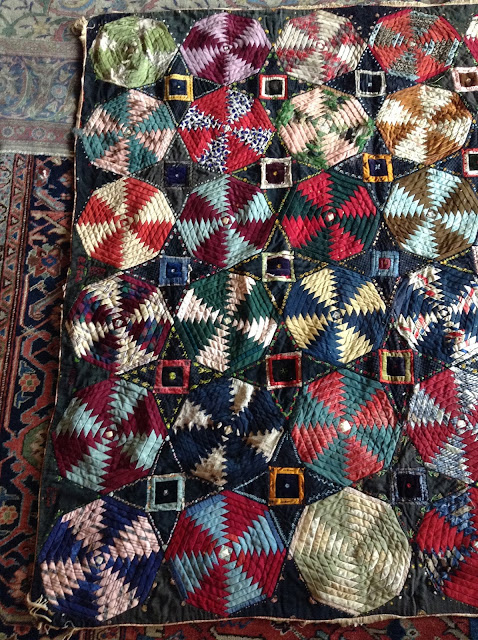
The above two pictures are of a quilt handmade and signed by Roxanna Elizabeth Cole herself. I was thrilled to see these as I had no idea she was a quilter, but shouldn't have been surprised given the historic timeframe.

Hilarie also sent the following pictures of a poem that Roxanna wrote and which was handwritten on one of the quilts that she had made.

Handwritten at the top was, "Lines handwritten in ink on a lovely old cotton quilt of patchwork in geometric shapes with embroidery in silk and chenille, including flowers and butterflies, etc."


The poem reads:

I've looked on rarer fabric
The wonders of the loom
That caught the flowers of summer
And captive held their bloom.

But not their wreathing beauty
Though fit for queen to wear,
Can with one household treasure
That's all mine own compare.

It has no golden value
that simple patchwork spread
It's squares in homely fashion
Set in with green and red:

But in these faded pieces
For me is shining bright,
Ah, many a summer morning.
And many a winter night.

The dewy breath of clover;
The leaping light of flame
Like spells my heart come over
As one by one I name.

These bits of old time dresses - 
Chintz, cambric, calico
That looked so fresh and dainty
On my darlings long ago.

This violet was Mother's
I seem to see her face
That ever, like the sunrise
Lit up the shadiest place.

The green was worn by June,
The sober gray was mine
And baby Laura the sprinkled pink
With buff and blue combine
And Bettie wore this mellow brown
Where dainty roses shine.

I turn my patchwork over, 
A book with pictured leaves
And I feel the lilac fragrance
And the snowfall on the leaves.

Of all my heart's possessions
I think it least could spare
The quilt dear "mama" pieced at home
When children all were there.

Roxanna Elizabeth McGee Cole

Hilarie told me that she was looking for the quilt that had that poem handwritten on it and that every time she reads the poem she cries. To see a handmade quilt with a handwritten poem on it reflecting on where the various pieces of fabric came from is so touching. Talk about a beautiful and cherished family heirloom.

In my previous research I learned that Roxanna's name was also spelled as Roxana from time to time. Hilarie confirmed this and said, "I think that Mom started spelling the name differently, but in various notes before Mom's article was written, I see Roxana." As a loving tribute to her great, great, great grandmother she named her daughter Roxanna.

The four pictures shown below are from the exceptional patchwork octagonal quilt that Roxanna Elizabeth Cole made.


Just look at the intricate details in the close-up picture above of the multicolored patchwork octagons created from multiple trapezoid rows with a log cabin center square. Each of the octagons is surrounded with 5-point stars with double or triple center squares. Can you image how much time it took to hand make this quilt and the artistic skill involved. It's just astonishing.

Hilarie mentioned that her mother, Estelle Johnston, had written an article on Roxanna Cole's cloth dolls which was published in Dolls magazine - November 1994 and presented at the Rosalie Whyel Museum of Doll Art. Estelle and her husband Jon loaned the museum four Roxanna Cole dolls which were created by Jon's great, great grandmother in the late 19th century. The Rosalie Whyel Museum of Doll Art, which was established in 1992, closed in February 2012.

Hilarie also sent the following four pictures of the article her mother, Estelle Johnston, had written which was a treasure trove of information on Roxanna Cole. Her article was titled, " Heirlooms of the Heart." The description was, "An unsung Victorian heroine leaves the legacy of her cloth dolls and creative talents to future generations."

I was thrilled to read this article by Estelle Johnston as, finally, there was some information on Roxanna. Here's a few excerpts from Estelle's article:


"Roxanna Elizabeth McGee was born in Tennessee on August 3, 1825, and by the age of six had already made a doll. By her own description, it was life size, handsewn of cloth, and stuffed with bran, rocks, and nails to make it the weight of a real baby. In 1842 she married William Russell Cole, a merchant in Ripley. Mississippi. Between 1846 and 1867 she recorded the births of five children in the family bible: three girls and two boys. Her last baby, a girl, died young, as did many infants in the 19th century. Other important dates are unclear, but a letter written to a cousin in 1862, Roxanna described the that had made her husband sick in body and mind, "old, bent, angry and almost disheartened." He is thought to have died in 1867 or early 1868. She later spoke of being bereft of loved ones upon whom she had depended for support, but Roxanna refused to give in to the double-edged panic of grief and poverty. Instead, she put her needle and paint brush to work."

Roxanna followed her youngest son, William, and her daughter-in-law, Molly Hunt, to Conway, Arkansas and started making her cloth dolls.


According to Estelle's article in Dolls magazine and an article by The Boston Daily Advertiser in 1898 Roxanna first tried to sell her dolls in Memphis and New Orleans, but decided New York might be a better fit due to its' wealthy and aristocratic patrons and, hopefully, more demand.  Despite being told not to send rag dolls to the merchant she had contacted, as the merchant was already overstocked, she sent two of her exquisite cloth dolls.

According to Estelle, "Satisfied that the visitors and shoppers in the great market had never seen anything in the doll line comparable to the exhibit which she could send, she determined to renew her efforts to find a market there in New York."

"She says: "I took the liberty of sending two, anyhow; and it was not long before I had the pleasure or receiving an order for a whole dozen of my beautiful babies."  

Soon she was receiving orders across the continent and from Germany.


According to Estelle's article Roxanna not only made dolls to sell, but for her own pleasure, as well as for her family members. However, she didn't only make dolls, she also made amazing art quilts and 3-dimensional art pictures like the one shown in the article photo above and blown-up in the photo below.


According to Estelle's article: "One three-dimensional picture in the double frame of gilt and wood originally had leather flowers (another Victorian craft) applied all around, which have dried and disintegrated. But the scene itself is intact and a masterful interpretation of a doll panel described in a ladies publication of 1883, which suggested the use of a "puppet" cut out from a picture. Roxanna combined this idea with the technique of making pictorial scenes from bits of vegetation- in this case, a strip of bark and dried firs that form a tree with a hanging swing. The doll children are lightly padded figures with embroidered cloth faces and hands, dressed in lightweight wools with tiny beads for buttons and embroidery for trimmings. They have curls of human hair (no doubt snipped from members of the family) and tiny heeled leather boots. The dog appears to be fashioned of cotton wool with stitching and paint strokes to suggest tan spots. The entire scene is mounted on dark velvet. It is no longer known whether this picture marked any particular occasion, but even great, great, great grandchildren are still charmed by it."

Hilarie told me that one of her cousins has this picture and also has one of Roxanna's quilts - but, not the one with the poem.


Hilarie had this to say about her great, great, great grandmother: "I think that she was an amazing woman and her work has lasted because it is of a quality that is rare. The work of Izannah Walker is beautiful and masterful, but there is a consciousness of the finished "product", of production itself, which of course is one reason why there are more of them around."  I couldn't agree more.

There is no doubt that Roxanna was an extremely gifted artist capable of creating exquisite pieces in different mediums. Whether it was cloth art dolls, intricate art quilts, or astonishing 3-dimensional pictures she was extremely gifted and extremely talented. She was certainly an artist who believed in herself and her art and, certainly, wasn't going to let a little rejection from a merchant get the better of her.

I have to wonder, given her immense talents, what astonishing creations she would be making given all the tools and supplies available to artists and crafters today. With the patience of a saint and eye for detail you would think that "the sky's the limit."

I am so appreciative to Hilarie for contacting me and providing me with the information on her amazing great, great, great grandmother and pictures of her astonishing work. Thank you so much, Hilarie. Your great, great, great grandmother is a true inspiration for us all.

Thursday, September 01, 2016

Gotta Love Scarecrows, But A Teddy Bear As A Scarecrow!


You can't be a doll designer or doll pattern designer and not have one, two, three, four or more scarecrow dolls. They can be primitive, classic, scary, well-dressed, tattered, large or small bodied, cheerful, scary, etc. It doesn't matter. They're a staple of every crafter. Why is that? Why are we so enthralled with them? I'm not sure, but I'd like to find out.

That got to me thinking about scarecrows and their history. Oh, boy! Another research project. For all my blog readers you know how I HATE research projects!

The definition of a scarecrow is 1) an object for scaring birds away (i.e. an object in the shape of a person dressed in old clothes, set up in a field to scare birds away), 2) a poorly dressed person (i.e. somebody who wears ragged clothes) , and 3) something frightening, but not dangerous.

They say that farmers have been making scarecrows for more than 3,000 years with the earliest know written fact being written in 1592. In the 1700's the farmers in the American colonies needed more and more grain. The farmers decided that neither they nor the scarecrows were sufficiently protecting the crops so the towns started to offer bounties for dead crows.

Well, things went too far (which is what usually happens) and so many crows were killed that in the 1800's the colonies had a severe problem with an over population of worms and insects that had previously been eaten by the crows. The worms and insects were destroying more crops than the crows had (that figures). So the farmers took to making scarecrows again.

While they have traditionally been known as scarecrows they have had several names and have taken on several forms. In Pennsylvania the German farmers built human looking scarecrows called "bootzamon" or bogeyman. The "Bootzamon's" body was a wooden cross and his head was a broom, mop top, or piece of cloth stuffed with straw. He usually wore old overalls, shirt, straw hat, and red handkerchief around his neck.

Sometimes more than one was built (everybody needs a little company, even scarecrows). The German farmers even had a "bootzafrau" or bogeywife. After all, every scarecrow needs a partner, don't they? The "bootzafrau" was usually dressed in a long dress or coat, wearing a hat or sunbonnet, and was placed in the opposite end of the field. So, you had a "bootzamon" on one end and a "bootzafrau" on the other end. Wonder which one really wore the pants in that family!


During the Middle Ages the German farmers made wooden witches and put them in the fields at the end of the winter. They believed that the witches would draw the evil spirit of winter into their bodies (which is why they were so ugly) so spring would come.

In Egypt, scarecrows were used to protect the fields along the Nile River from quail. The farmers would put wooden frames up with nets and would hide in the fields to scare the quail in to the nets. Once captured they, of course, would take them home and eat them.

They say that in Greece 2,500 years ago that wooden scarecrows were made to look like Priapus, the son of the god Dionysus and the goddess Aphrodite. According to legend Priapus lived with vineyard keepers and was very ugly. When he played in the fields he was so ugly the birds were frightened away. Maybe it's me, but if Priapus was the son of Aphrodite (wasn't she the goddess of love and beauty) I would think the crows would have flocked to him.

Japanese farmers hung old rags, meat, fish bones, etc. from bamboo poles in their rice fields. They named their scarecrows "kakashis" which means smells badly because they would set the sticks on fire and the smell was so bad that it drove the birds away. Of course, it probably drove the neighbors away, but that's a different story.

In Medieval Britain the scarecrows known as "bird shooers" were live boys 9 years old or older. I bet you're thinking I'm going to tell you that they were tied to the wooden crosses and hung in the fields. The young boys patrolled the fields carrying bags of stones which they would throw at the birds to chase them away.

After the Great Plague in 1348, when approximately half the population was killed, the farmers started to stuff sacks with straw and hung these in the fields as there were not enough little boys around to scare the birds away. They would stuff the sacks with straw and make carved heads out of gourds.


Most of the Native American Indian scarecrows were adult men. They would sit on raised platforms and would howl and shout at the crows if they came near the corn. Creek Indian families actually moved into huts within the corn fields during the growing season to protect the crops from birds and other prey. In New York, the Seneca Indians soaked their corn seeds in a poisonous herb mixture that would make the crows fly around like crazy and scare the other birds away.

It's been reported that one of the scarecrows used by the Navajo took the form of a teddy bear, which was hung from the top of a pole. That's a new one for me. A teddy bear as a scarecrow. You'd think the crows would want to cuddle the bear not fly away from it. Could be a new doll line. Hmmm.

In any event, the scarecrow has clearly been around a very long time and clearly has taken many forms. Whether you believe in the tradition or not scarecrows are loved by artists, crafters, writers, and children the world over. For doll designers and crafters we just can't have enough of them. I know, I can't.

For crafters it really doesn't matter whether you are a crafter of primitive crafts, Victorian crafts, country crafts, etc. No matter what type of crafter or designer you are we all still have one thing in common: we are all still in love with scarecrows. I know I am and I suspect you are as well.

Tuesday, July 19, 2016

Who Doesn't Love Paper Dolls? - Plus My Paper Dolls Pinterest Board


Image Courtesy of The Metropolitan Museum of Art
Ballerina and Bloomer Girls (Prima Donna) Paper Dolls
Publisher:Littauer and Boysen
Purveyor:Dennison Manufacturing Co. (New York, NY)
Date:1890–1905
Medium:Lithographs
Dimensions:each: 14 3/8 × 6 1/8 in. (36.5 × 15.5 cm)
Classification:Prints
Credit Line:Gift of D. Lorraine Yerkes, 1959
Accession Number:59.616.403a-g

I don't know if you're like me or not, but I like to reminisce about my childhood and the dolls, toys, or items that I loved to play with. In doing so I always say to myself, "Why didn't I save them?" I wish I had saved all of them. Some of them would be worth a fortune today.

Unfortunately, we moved a few times and old toys were discarded. Plus, what child thinks about saving something so they can have it 50 years down the road? None, that I know of and certainly not me. So, all my old toys, "Barbie" dolls, other dolls, and "paper dolls" were thrown away.

Today, with the advent of computerized doll makers and graphics "paper dolls" are making a comeback. You can create your own doll online or in your own graphics program and then print it out on your color printer on cardboard stock. Then just cut it out just like you did as a child. You're all set to play. How great is that?

In the paper, scrapbooking, stamping, and mixed media area there are so many gorgeous paper dolls being created and supplies generated to help you with that. In the mixed media and scrapbooking arena paper dolls are becoming an art form. Some of the creations are just astonishing. If you'd like to see some beautiful paper art dolls my" Paper Art Doll  Creations" Pinterest board is here.

Plus, with the advent of the computers, paper dolls went virtual.  You can create your own avatar dolls and virtual doll worlds. Over the years I've created a few avatars of my own, like my YoVille Linda shown below:


The Linda avatar on the left is the original YoVille (now known as YoWorld) avatar I created back in 2006.  The Linda on the right is the "Punk" version.  DollZ, which is what digital dolls are now known as, are extremely popular with numerous websites devoted to them.  You can create the dolls, create their clothing, their homes, their worlds, their friends, etc.  It's mindboggling.

I would have loved having everything that is available nowadays for paper doll creating when I was a child. I can remember sitting on the floor for hours with my scissors and painstakingly cutting out pictures from fashion magazines, which I used as paper dolls. Or, cutting out the "paper doll" pages from my mother's magazines. Cutting precise lines with the round tip children's scissors was a little difficult if not downright impossible. However, I did my best which is all anyone can ever really ask of you.

Then I would sit there for hours on end using my "paper dolls" and play acting. Sometimes we would have a "tea party." Other times we'd have a fashion show with everyone lined up. Then my older brother would come in an mess everything all up.

Ah, the joys of childhood and siblings. That's an article for another day. Back to the "paper dolls."

On my list of "To Do's" is to create my own "Victorian paper dolls" based upon my own doll designs. The problem is finding the "time" to do so. There are just so many things I want to try and so many things I want to do. My own "paper dolls" is among them.

Of course, thinking about "paper dolls" got me to wondering about their origin. If you're a reader of my Linda's Blog you know how much I love traditions and research.

The who, what, when, and where did mysteries. So, I thought I'd find out the history of paper dolls and the traditions surrounding them. When exactly did the "tradition" of playing with "paper dolls" begin? So, I did a little research.

It seems that paper dolls have a history that is as varied as the paper dolls themselves.  Paper dolls over the centuries have been created for various reasons and in various forms, some of which would not resemble the paper dolls we are accustomed to today.

According to Wikipedia.com, "Paper dolls have been around as long as there has been paper. Faces or other objects were applied to the paper and they were used during religious rituals and ceremonies in the Asian cultures many centuries ago. The Japanese used paper for Origami, artful paper folding, and dating back to 800 AD they folded paper figurines in the shape of Kimono. Balinese people made paper and leather into puppets since before the Christian Era. Other cultures around the world have had paper formations or paper art, including in Poland, where they were called Wy'cinanki. These early types of paper figures differ from typical paper dolls today, as no clothes were made to be used with the dolls."

It is said that Marco Polo may have brought the tradition of using "paper dolls" for puppet shows home with him. The "dolls" were printed on "papyrus" and then glued to sticks to be used as puppets for puppet shows.

Other historians refer to life-size cutouts of "nobility" used during stage performances as the start of paper dolls. Paper dolls first appeared in Paris in the 18th century, during the reign of Louis XV. On the other side of the English Channel during this time period, British printers printed "paper dolls" on flat sheets and added moral stories to go along with their creations.

According to some historians; Paper dolls began in the mid-1700s amongst the European fashion centers of Vienna, Berlin, London and Paris. Here they offered paper dolls with costumes.

For other historians, "paper dolls" began with "traditional" dolls and started in the late 18th century with French seamstresses and dressmakers as a selling tool. They would create 8" tall figures on cardboard with outfits and distribute these to their favorite customers.

In 1810 the first commercial "paper doll" called "Little Fanny" was created by S. & J. Fuller & Co. The "Little Fanny" 15-page book was expensive to buy so it was initially only popular amongst the wealthier families. In 1812 "Little Henry" was published in America by J. Belcher.

Beginning in the 1830s, celebrity paper dolls and "royalty" paper dolls began to appear. In Pioneer America, paper was a prized resource. If children were lucky enough to get paper dolls, they treasured them and saved them between the pages of a book or in a carefully guarded box.

The cost of paper later changed with the invention of mechanical grinding machines, which became a ready source for pulp paper. However it wasn't until 1838 when cheap paper made from wood pulp (i.e. newsprint) was widely used that "paper dolls" was made affordable to the average child. As paper became less expensive and more common, dolls were mass produced on inexpensive cardboard and became readily available to children.

In the 1800's in the United States "McLoughlin Brothers" quickly became one of the largest manufacturer of paper dolls. They printed them on engraved wooden blocks. McLoughlin Brothers was bought in 1920 and is now known as "Milton Bradley."

Until the development of color printing, paper dolls were colored by hand. In America, Civil War widows often earned money by embellishing the printed paper dolls.

Early printed doll clothes did not include tabs for dressing the dolls, as is common with paper dolls today. Instead, children painstakingly attached the clothes with tiny drops of sealing wax. They took great care when they attached their clothes to their dolls so they wouldn't tear the paper doll.

Early paper dolls were available in various stages of modesty. Some came with permanently printed clothes. Others came with multiple layers of clothes, while others had printed underwear and required only outerwear. By the 1800s most commercial paper doll clothes featured tabs.

Homemade paper wardrobes often rivaled the silken fashions worn by real ladies and gentlemen of their respective era. Some artists used bits of cloth, tissue paper and magazine pictures to craft beautiful ball gowns.

And, something near and dear to my heart - During the Victorian era, Godey's Lady's Book, was the first magazine to publish a paper doll in their November 1859 issue. This paper doll was printed in black and white with a coloring page of costumes.

At the turn of the century, department stores soon discovered that paper dolls were the ideal form of advertising. Specially designed dolls appeared in ladies magazines such as the Good Housekeeping, Ladies Home Journal, Ladies World, McCalls, Pictorial Review and Woman's Home Companion.

The most popular paper doll of the mid-20th century was probably Betsy McCall, created by Kay Morrissey. Since 1962, Barbie paper dolls have become the most popular among American children.

Today, "fine art paper dolls" and "paper art dolls" can be found on many websites and are sometimes drawn, painted or printed on paper. They even have their own Artist Trading Cards (ATCs) which can be traded or swapped.  And, if that isn't  modern enough you can arrange a playtime with your avatar and your friends in your own virtual community.

Collecting paper dolls is a wonderful hobby and one I would like to start. If you love historic fashions, ball gowns, personality paper dolls, modern characters, animals, cartoon characters, etc. there is a paper doll somewhere for you.

Paper dolls can be collected very inexpensively, are available for free downloads on many websites as printables and coloring pages, and are available for free in many magazines and ezines.

There are also hundreds of books for sale that include paper dolls of various types and historical periods to cut out and play with.  I have bought several of these with paper dolls dressed in  clothing from the Victorian Era just to see the beautiful dresses.


If all that isn't enough you can search for paper dolls on Pinterest and find thousands of paper doll examples to choose from here.   "Paper Doll" collecting is a wonderful way to relive childhood memories, and share something "new" with your children, grandchildren, and friends.

As mentioned, I played with paper dolls as a child and never stopped loving them. However, the paper art doll creations of today are nothing at all like the paper dolls I played with. They're amazing works of art.

I love the fact that so many of the scrapbooking and mixed media paper doll designers are willing to share their paper doll making making secrets by creating free tutorials, patterns and how-to's for all of us to use.  So, of course, I had to set up a Paper Doll Making Pinterest board to house all the wonderful links I've found.  If you love paper dolls, too, here's a few tutorials, video's and how-to's to help you with creating your own works of art.

Happy paper doll making.

If you'd like to know more about the history of paper dolls there is a wonderful "History of Paper Dolls" article by Judy M. Johnson on the OPDAG (Original Paper Doll Artists Guild) here.

I hope you enjoyed reading about the history of "paper dolls" .

Maybe I've encouraged you to become a "paper doll" collector, too. I know that I'm starting my own collection and, if I could just find some time, developing my own series of "Victorian paper dolls." So, who wants to swap paper dollies with me?