Sunday, May 03, 2015

I Signed Up For My Artful Gathering Classes - YIPPEE!


I am so happy.  I signed up for my Artful Gathering  classes yesterday and couldn't be happier.

I signed up for 3 classes this year, which might be a bit of an undertaking.  I've only taken 2 classes every year for the previous years; one for Session 1 and one for Session 2.  This year I have one in Session 1 and two in Session 2.  Hope I can handle it.

This will be my 4th year taking online classes at Artful Gathering and I can hardy wait. I have loved each and every class I've taken there as the instructors are fantastic and the classes are always delightful. I've had a blast in each class learning something new and, best of all, making wonderful new friends.

Last year there were so many fabulous classes to choose from it was hard to decide. This year it was nearly impossible to choose.  There were just SO MANY wonderful online classes that I wanted to take.

Truth be told, I wanted to take them all, but that is definitely not possible. So, here's what I chose:


Hally Levesque - Session 1- Bonnets & Bows: A Regency Doll Project


Mary Jane Chadbourne - Session 2 - Tiny Topia & The Magic of Little Things


Debbie Anderson - Session 2 - A Romantic Journey On Canvas

Session 1 runs from June 6 to July 17 and Session 2 runs from July 16 to August 16,  

If you've always wanted to take an online art and/or craft class you won't be disappointed in any of the Artful Gathering classes.

Hope to see you there.

Tatting & Doilies and Two Crafts I'd Love To Lean How To Master


I just love doilies and always have. In fact I have doilies everywhere throughout my house and love decorating with them.  I just wish I could make them. Crochet and tatting, however, have never been my forte. Maybe someday I'll learn and if I do perhaps these tutorials, video's and how-to's will be helpful.

If you love my Doily Tutorials, Video's, Patterns and How-to's board please follow my board by clicking on the link above.


One craft that I could never master was crochet. If I couldn't master crocheting I can't imagine how I'd ever learn tatting.  It just seems way out of my ball park! However, I would love to learn how to tat as the creations always look so beautiful.   If I ever do maybe these tutorials, video's and how-to's will help.

If you love my Tatting & Lace Crafts Tutorials, Video's, Patterns and How-To's board please follow my board by clicking on the link above.

Saturday, May 02, 2015

Who Doesn't Love Amigurumi, Crocheting, and Knitting?


I learned how to knit as a young child. One year I decided to knit these really big Christmas stockings with different colors and images and gave them to my family for Christmas presents. Every one loved them - especially the kids as they held a lot of presents. Unfortunately that was so long ago we no longer have those stockings and, I, foolishly never took a picture.

What I do remember, however, is thoroughly enjoying knitting. I haven't done it for many, many years and would love to find some time to do so as I keep adding pins to my Pinterest knitting board that look like wonderful knitted projects to try.

I've already pinned over 250 pins to my knitting board - all of which I want to try.  I know how to knit so that should be no problem and have always wanted to try those really big knitting needles they have today.

If you would like to learn how to knit hopefully these tutorials, video's and how-to's will be helpful.

If you love my Knitting Tutorials, Video's, Patterns and How-To's board please follow my board by clicking on the link above..


I've got close to 700 amazing crochet tutorials on my crocheting board all of which I'd love to try.  Of course, I'll never be able to do all of them.  First and foremost I would need to learn how to crochet. It's one craft that I could never master as a kid.  Maybe now I'll be able to.

Hopefully when I finally have a chance to learn how to crochet and crochet something some of the how-to's and pins will come in handy.

If you love my Crocheting Tutorials, Video's, Patterns and How-To's board please follow my board by clicking on the link above.


It should come as no surprise that I also love amigurumi as it basically involves knitting or crocheting little animals and dolls.  Truth be told it's the adorable little crocheted amigurumi animals that are the real impetuous for my learning crochet.  I'm determined to master this as I just have to make some of these adorable creatures.  With close to 250 pins on my Amigurumi Pinterest board I'd better get started.

If you love amigurumi or want to learn how to do this hopefully these tutorials, video's, patterns and how-to's will be helpful.

If you love my Amigurumi Tutorials, Video's, Patterns & How-To's board please follow my board by clicking on the link above.

For sure when and if I do start to knit and finally learn how to crochet I'm going to need some of my sister's Rock Garden Alpacas Fiber handspun yarn.  That is, if I can convince her to give me some of it. Wink! Wink! Oh, baby sister - I hope you're reading this post.....


Friday, May 01, 2015

I'm In Love With Penny Wooden or Peg Wooden Dolls


Image Courtesy of Wikipedia.com

As you all know I absolutely love dolls of all kinds, shapes, and sizes.  However, while doing my research on the "The History of Faceless Dolls" I read an article about Penny Wooden Dolls, like the doll pictured above from Wikipedia.org, and fell in love with them.

According to Wikipedia.org, " Peg wooden dolls also known as Dutch dolls are a type of wooden doll from Germany and the Netherlands. They originated as simple lathe turned dolls from the Val Gardena in the Alps. These dolls were sold undressed. Young girls would then make their clothing from scraps of fabric."

"Other similarly constructed wooden dolls, using a jointing technique where the arms and/or legs are attached to the body with pegs, are some of the oldest surviving dolls, and were made worldwide. Sometimes a peg wooden doll's arms or legs are locked together by the jointing system, so if one arm is moved the other will move. An advanced form of peg joints is where the body pegs are "split" and attached separately allowing independent movement."

I was intrigued by the picture, shown here, and wanted to know more.  So, of course, I had to do some research.  Here's what I found.


Page 146 of the Information Please Girls' Almanac by Alice Siegel said this about Pennywooden Dolls, "These are English dolls carved out of wood.  The joints are moveable and fastened by pegs. These are also know as dancing dolls."

My question was whether Peg Wooden dolls and Penny Wooden dolls were the same thing.  I had to find out.

According to an article on eHow.com entitled Penny Wood Dolls History by Christy P., "Penny wood dolls were known by a variety of names, including peg wooden dolls, penny woodens and wooden poppets. These dolls typically resembled wooden clothespins with simple peg joints."

So now we know they may be called Dutch dolls, peg wooden dolls, penny wooden dolls, pedlar dolls, and tuck comb dolls.

There was a Grodnertal Wooden Peddler Doll that sold for thousands of dollars on the Rubylane.com website.  According to her description she was a spectacular example of a Grodnertal wooden pedlar doll.

There was a Grödnertal Carved Wooden Doll, ca. 1820 on the PBS.org WGBH Roadshow Archives website here.  This doll was appraised at several thousand dollars and was a tuck comb doll due to the little comb on the top of her head.

So now we know they may be called Dutch dolls, peg wooden dolls, penny wooden dolls, pedlar or peddler dolls, tuck comb dolls, Grodnertal Wooden Peddler, and Grodnertal carved wooden dolls.


The doll pictured above is from a wonderful post on the Dolls from the Attic...Mis Muñecas blog, which I absolutely love,  about Grodner Tal, "Tuck Comb," Peg Wooden Dolls.    This post is filled with information on these dolls as well as a ton of beautiful pictures. If you would like to read this post please click here.

According to this post, "From the home industry of the Groden Valley, Grodner Tal and South Tyrol, came the little peg wooden dolls. These are some of the oldest surviving dolls. Although the term peg-wooden refers to a jointing technique the term came to be synonymous with lathe turned dolls from these areas of the Alps. They were the inexpensive play dolls of generations in both Europe and America."

"Most of the dolls had combs carved into their heads-hence the term Tuck Combs. Their heads and bodies were lathe turned as one piece and had simple peg joints, but the larger dolls had ball joints and even swivel waists. They had elongated graceful proportions, nicely carved details, painted slippers and sometimes with wood pendant earrings."

"The hair is usually painted with curled bangs. Once painted and varnished they were ready for whatever adventures their little owners could conjure up. They are often referred to as German Tuck Combs, probably because they were sold in the German Nuremberg Toy Market, and sometimes incorrectly they are called Dutch dolls but this was a mispronunciation of the word Deutsch."

This was confirmed by a excerpt from the Early North American Dollmaking: A Narrative History and Craft Instructions by Iris Sanderson Jones in 1976 which said, "Long before the American Revolution, Grodner Tal doll salesmen carried great containers of toys and dolls into Italy and Spain.  By the Civil War these dolls were known to English children as "Dutch dolls," probably the same distortion of the word "Deutsch," or "german," which occurred with the "Pennsylvaia Dutch" in the United States."

So, now we know they aren't actually Dutch dolls, but mispronounced Deutsch Dolls.  This means they've been called Dutch aka Deutsch dolls, peg wooden dolls, penny wooden dolls, pedlar or peddler dolls, tuck comb dolls, Grodnertal Wooden Peddler, Grodnertal carved wooden dolls, Grodner Tal dolls, and Grodner Tal peg wood dolls.

According to the Wood Dolls article by By Denise Van Patten, Doll Collecting Expert, on the About.com website, "Dates of Production Of Wood Dolls: As mentioned, wood dolls are known from ancient times. Italian creche figure examples are known as early as the 1500s (very rare) and English wood dolls from the late 1600s and early 1700s are quite rare. English wood dolls are more plentiful from the late 1700s and early 1800s, and German Grodner Tal and Peg Wood dolls are from the 1800s. A cottage industry created peg woodens well into the 20th century, and there are artists today still making wood dolls."

We learn from an exhibit on the Illinois State Museum website that,  "Berechtesgaden, Grödner Tal, Oberammgergau--Peg-wooden Dolls - In several German-speaking areas of central Europe, the making of wooden dolls with peg jointing became an important part of the local economy. Most of these dolls were made in the mountainous area surrounding St. Ulrich, which was part of Austria until World War II, and is now part of Italy. In this area, called the Grödner Tal (Valley), wooden dolls and doll heads were being carved as early as the 1700s. By 1800, about 300 wood carvers in the Grödner Tal were making dolls, and sales agents took their work all over the world. The farm families living in the mountains spent their winters making dolls in a wide range of sizes from local wood, mostly pine. Most of the attention was put into the head, which required the most skill in carving and painting. The peg-jointed wooden bodies allowed for movement of the arms and legs. Peg-wooden dolls were also made in the forests of Thuringia (a northern area of Germany) and in the Berchtesgaden and Oberammergau Tyrolean area. Craftspeople making these dolls were also working in England, America, and China, but the quantities produced could not match those of the Grödner Tal. The Verlagers in Grödner Tal were important middlemen who organized production, purchased dolls from the carvers, stored them, and marketed the dolls for export. By 1873 almost the entire population of the Grödner Tal (3,500) were involved in the doll business, and one Verlager had thirty large showrooms containing millions of dolls."


There is an utterly adorable children's book published in 1895 entitled "The Adventures of Two Dutch Dolls and a 'Golliwogg' by Florence K. Upton" that is visible on the Gutenberg.org website that is so charming you have to read it.  I loved the story and the adorable illustrations.  If you would like to know more about the author, Florence K. Upton please click here.

Image Courtesy of Theriaults.com

The TWO GRODNERTAL WOODEN DOLLS,MOTHER AND SON,WITH ORIGINAL COSTUMES shown above were listed on the Theriaults.com website.  Here's what they had to say about them:

According to their description: "TWO GRODNERTAL WOODEN DOLLS,MOTHER AND SON,WITH ORIGINAL COSTUMES - Lot Number: 78 - 9" (23 cm.) Each is all-wooden with one-piece head and torso, dowel-jointing at shoulders, elbows, hips and knees, the woman with black painted hair decorated with highly- stylized spit curls and tuck comb, elongated throat, and tiny centered painted features; and the boy with short black hair, suggestion of sideburns, painted features. Condition: good, unrestored, costumes are original albeit frail. Comments: Grodnertal, circa 1830,the dolls were featured in Ackerman's Dolls in Miniature. Value Points: both dolls wear their original stylized costumes."

How beautiful are they? Are you in love with penny wooden dolls, too?

The White House Doll

Image Courtesy of  Smithsonian National Museum of American History

In doing my research for the "The History of Faceless Dolls" I ran across several articles regarding a historical doll named "Sally" (shown in the picture above from the Smithsonian National Museum of American History) that is now in the Smithsonian and was otherwise known as "The White House Doll."  She was described as a rag doll, but from the picture above you'd think she was a china head doll.  So, of course I was intrigued and had to find out more.

According to the "Creating A Private Life" section of "Life and Death In The White House" this doll was made around 1829 for Mary Louisa Adams, granddaughter of John Quincy Adams.


According to Child Life in Colonial Days, Volume 1 By Alice Morse Earle - Published 1909"The White House doll spent the days of her youth in the White House  at Washington, with the children of the president, John Quincy Adams and is still cherished by his descendants."


Section VI of  Our Early Presidents, Their Wives and Children: From Washington to Jackson By Harriet Taylor Upton published in 1890 contains a section about the family of John Quincy Adams and his grandchildren, including Mary Louisa Adams, shown in the picture below from a painting owned by her husband, W. C. Johnson, Esq., Newburyport, Mass.


In Chapter 3 we learn from Mary Louisa's cousin, William, that, in his opinion, she never really had a young life.  "Notwithstanding that it is certain that "Mary Louisa" had a doll who is "still living;" "a big rag baby 'Sally,' the first and only doll," writes Mr. Johnson who owns and cherishes "Sally;" "a personage," he says, "who has served each subsequent childhood in our family." She had it in the White House days.  Her great-aunt, Mrs. Thomas Boylston Adams made it for her just before entries in the bridesmaid dairy...." which were February 26th, 1829.

The section on John Quincy Adams and his family starting on Page 292 of Our Early Presidents, Their Wives and Children: From Washington to Jackson By Harriet Taylor Upton is an interesting section to read and provides a lot of insight into the lives of John Quincy Adams, his wife, their children, and grandchildren.


On Page 29 of The Doll Book By LauraB. Starr published in 1908 we learn that "The descendants of John Quincy Adams treasure a shapely rag doll who spent the days of her youth with the children of the President in the White House in Washington."


The Smithsonian Book of Presidential Trivia By Smithsonian Institution includes the picture of "Sally" shown above.

I know the dress is pink and white, but was hoping to find more information on the dolls face.  At first I thought she was a china head doll, but some of the descriptions say she is a handmade rag doll so she probably wouldn't have a china head.

The question is if she was a painted and cloth face doll was her face needle sculpted.  Can you tell?

I guess I'll just have to visit the Smithsonian and see for myself.

There's Something Very Endearing About Wishbone Dolls


Image Courtesy of Ebay by abclovell

Before doing my research for faceless dolls I would never have thought about making a doll from a turkey or chicken wishbone.  However, knowing the history of the colonial period and the pioneers and using materials on hand I shouldn't be surprised as to wishbones being used to make playthings.

Some of these dolls were faceless, but most had faces.  Even though they didn't fit the criteria for my "faceless" dolls research I was intrigued and had to know more.  Here's what I found:

They were also known as pen wiper dolls that were used about 150 years ago.  In Colonial times people kept them on their desks to wipe away extra ink from their pens.

The wishbone doll shown in the picture above is for sale on Ebay by abclovell and can be found here.


Page 205 of The Doll Book written in 1908 by Laura B. Starr under the Homemade Dolls chapter talks about the merry-thought doll which is made out of wishbones from turkeys, chickens, ducks, and birds - with all the different sizes being perfect for different family members.

According to the chapter, "The merry-thought doll affords no end of pleasure and amusement.  The wishbones from turkeys, chickens, ducks and birds offer various sizes for a large family of these dolls.  The head may be molded of ceiling wax, black, white or colored; here is a chance to show skill and artistic ability.  Again a head may be penciled on the flat surface of a cork and each end of the wishbone thrust into or glued on to the other pieces to give the manikin necessary stability, and make it flat-footed enough to let it stand alone unaided."

"Doll pen wipers are made from a wishbone and dressed like a ballet dancer.  They usually wear a card around the neck upon which is printed the following epitaph:  

One I was a wishbone and grew upon a hen,
Now I am a little slave and made to wipe your pen."

From my research I discovered that most wishbone dolls had cork heads, walnut heads, cloth heads, or wax heads.  Most had faces, but there were some that didn't so I gave some thought to including them in my The History of Faceless Dolls but decided not to.  

So I decided to write this blog post about them - mainly because I find the wishbone dolls so charming.

If you would like to see a picture of fourteen folk art wishbone dolls please click here.


Image Courtesy of  National Museum of Toys & Miniatures

The pen wiper "I'm So Fancy" doll pictured above is from the National Museum of Toys & Miniatures website. According to their website, "We’ve got to hand it to the Victorians: they were recycling and reusing a century before the country had heard of Al Gore or Earth Day! Everyday objects like wishbones, spools and nut shells were all given a new life as fanciful, yet functional art objects. All the rage in the 19th century, this crafty trend of turning trash into tiny treasures resulted in Victorian fancies."

Also, according to their website: "While T/m’s  Victorian fancy doll isn’t exactly winning the beauty contest amongst the dolls in our collection, she certainly gets high marks for functionality and being “green.” Her body consists of a wishbone wrapped in muslin and plaid fabric scraps; and her head is painted cork. Her dress is actually intended to be used as a pen wipe, a desktop necessity in the days of the dip or nib ink pens. The tag pinned to her reads, “Once I was a wishbone, And grew upon a hen. Now I am a ‘Spinster,’ Made to wipe your pen."


According to The Information Please Girls' Almanac By Alice Siegel - Page 148, "Wishbone Dolls - In the late 1800's adults saved the wishbones from turkeys and chickens and made dolls out of them using a piece of cork for the head and sealing wax for the feet. The dolls were dressed in the fashions of the times."

If you would like to see or read more of this article please click here.


Image Courtesy of Liveauctioneers.com

I found the wishbone doll that is shown in the picture above on the Liveauctioneers website.

The description says the doll is a black faced doll, circa 1850 with a "ditty" sewn dress.

If you would like to see this doll please click here.

If you want to know how wishbone dolls are made the WikiHow website has a How to Make a Wishbone Doll article. According to the WikiHow website, "Wishbone dolls were made "in the olden days" before folks had all the material things they have today." If you want to read the how-to please click here.


There is a charming parable in The Churchman, Volume 46 from November 1882 - page 528-530 entitled, The Unhappy Wishbone,  about a wishbone "pen wiper" and learning the art of contentment.  It's a charming little story about a wishbone with a cloth face, an old lady and a little girl.  If you would like to read the story please click here.

In the story mentioned above the wishbone is described as a pen-wiper. Of course, I was intrigued by this as I had never heard of a pen-wiper before. Turns out it is a cloth or other material for wiping off or cleaning ink from a pen. Sometimes pen wipes were wishbone dolls - some with cloth heads, some faceless.


 Image Courtesy of Antiquesavigator.com

I found the Antique Black Americana Wishbone Doll Pen Wipe Vintage, shown in the picture above on the Antiquesnavigator website. If you would like to see a larger image of this pen wipe please click here.

I ran across a LeRoy Pennysaver & News from November 2013.PDF that had an article entitled, "Save The Wishbone by Lynne Belluscio" that is about wishbones dolls and contains pictures of three of her wishbone dolls with faces.While these wishbone dolls have cloth faces the article is very interesting.  If you would like to read the Save The Wishbone by Lynne Belluscio article please click here.

I also ran across an article in the Philly.com website entitled, A Little History In Black Dolls that was written by Lini S. Kadaba in  January, 1988.  It is a very interesting article about Barbara A. Whiteman who was giving a presentation  at Lincoln High about the history of black dolls. Two of the dolls that she showed were two tiny little dolls with chicken wishbone legs.  If you would like to read the A Little History In Black Dolls  please click here.

Image Courtesy of  Historic New England

The Pen Wiper Doll shown in the picture above is from the Historic New England website.  According to their website this is a pen wipe from 1900 - 1920.

Description - Black cloth doll with print dress and apron. Red cloth bandana tied on her head. Wearing a printed cotton dress; white cotton apron. Doll has no lower body. 

Credits: Maker unknown, Date 1900-1920 , Early 20th century, Location of origin United States, Material cloth cotton (textile), Object type Toy, Descriptive terms cloth cotton (textile), Doll
dolls slavery, Dimensions 4 3/4 x 3 3/4 (HxW) (inches), Accession Number 1949.952, Credit Line Bequest of Elizabeth R. Vaughan, GUSN 251679

If you would like to read more about this pen wiper please click here.


In Chapter VI Dolls and Doll-Houses of the Home Occupations For Boys and Girls book By Bertha Johnston, Fanny Chapin - Published 1908 we learn how the wishbone dolls were made:

3. Wishbone Doll (Wishbone, sealing-wax, material for trousers)

Clothe the two limbs in trousers and ink in the features upon the flat joining bone. Feet may be made of sealing wax melted, pressed into shape and attached while still warm.

 Image Courtesy National Gallery of Art,Washington.

The  Pen Wiper Doll Illustration  c. 1937 doll illustration is from the National Art Gallery.

Credits:Miller, Eugene C., American, active c. 1935, Pen Wiper Doll, c. 1937, watercolor, graphite, and pen and ink on paperboard, overall: 35.7 x 28 cm (14 1/16 x 11 in.) Original IAD Object: 5" high, Index of American Design, 1943.8.15392

Image Courtesy of  Horman Museum & Gardens

On the Horman Museum & Gardens website I found the wishbone doll pictured above.  Here's what they had to say about her:  Tales of the Unexpected: Dolly Mixture

Here is another bone doll, this time made from a bird. This amazing little doll is from Surrey, England and is made from a wish bone - the perfect shape for legs! The clothes are made from a scrap of leather decorated with beads and the head is made from an acorn. The acorn cup makes the perfect topknot hairstyle, or perhaps a hat.

There is something so endearing about these dolls. Wouldn't you agree?

Gotta Love Alpaca Fibers Boards on Pinterest


Four years ago my sister and her husband became alpaca farmers and started Rock Garden Alpacas. Two years later they started Rock Garden Alpacas Fiber for selling all their alpaca fiber products, including roving, raw fiber, carded batts, handspun yarn, hand dyed roving, and doll hair fibers.

My sister had given me several large (make that HUGE) bags of roving and several carded batts (which I loved) from her alpacas Sunflower, Ivy, Cosmo, Zinnia and Masquerade which I used to make my needle felted art dolls, like those shown in the picture collage above.   I loved working with the natural alpaca roving and carded batts - especially Masquerade's gray fiber batts.  It was fabulous for making the needle felted dolls.

Several years ago I was visiting my sister and learned how to card batts and dye roving.  It was a lot of fun and I came home with some wonderful carded batts and lots of bright and cheery dyed roving packs. I had Fall combination colors, beautiful blues and purples, Christmas colors and so much more.

Two years ago my sister started spinning her alpaca roving into yarn.  She subsequently learned how to hand dye her yarn and utilize several methods for plying it.  Last year she sent me a surprise package in the mail that contained some of her handspun alpaca yarn.  I was thrilled and put this to good use with some of my mixed media art dolls - especially the witches. I've used her raw alpaca fiber, alpaca roving (natural and hand dyed) and handspun alpaca yarn for some of my dolls hair and have to tell you it's just wonderful.

I keep looking for various ways to use her alpaca fiber products and have to tell you that the possibilities seem endless. I had so many little sticky notes for this project or that project or this method or that method that I'd like to try or thought she might try that it was getting a little unwieldy. So, I decided to set up Pinterest boards to handle all the pins. So now I have three wonderful Pinterest boards instead of thousands of yellow sticky's everywhere.


I have a spinning, carding, batts, roving and making felt tutorials, video's and how-to's board. I'm hoping that when my sister finally teaches me how to do this all these tutorials will come in handy.

If you love my Spinning Tutorials & Carding, Batts, Roving & Making Felt Tutorials, Video's and How-To's board please follow my board by clicking on the link above.


I have a dyeing fabric, yarn, wool, alpaca, ribbon & threads tutorials, video's and how-to's board. I love visiting that board just to see all the wonderful colors of the yarns and roving and some of the methods are very intriguing.

If you love my Dyeing Fabric Tutorials, Video's, Patterns and How-To's board please follow my board by clicking on the link above.


And, I have a weaving & loom tutorials, video's, patterns, and how-to's board. Hopefully, this will come in handy as well.

If you love my Weaving & Loom Tutorials, Video's, Patterns and How-To's board please follow my board by clicking on the link above.

I also set-up three other Pinterest boards - Amigurumi, Crochet, and Knitting.  I've already pinned over 250 pins to my knitting board - all of which I want to try.  I know how to knit so that should be no problem and have always wanted to try those really big knitting needles they have today.

I've got close to 700 amazing crochet tutorials on my crocheting board all of which I'd love to try.  Of course, I'll never be able to do all of them.  First and foremost I would need to learn how to crochet. Hopefully when I finally have a chance to crochet something some of the how-to's and pins will come in handy.

It should come as no surprise that I also love amigurumi as it basically involves knitting or crocheting little animals and dolls.  Truth be told it's the adorable little crocheted amigurumi animals that are the real impetuous for my learning crochet.


Thursday, April 30, 2015

After 250 Years It's Still The Bangwell Putt Rag Doll


Image Courtesy of The Doll Book written in 1908 by Laura B. Starr

When I was doing my "The History of Faceless Dolls" research I ran across a faceless doll that was created in 1765 and, 250 years later, is still in existence.  It was included in the Memorial Hall Museum Online -  American Centuries....View From New England  website that allows you to "Explore American history with hands-on activities, exhibits, lessons, historic documents and artifacts."

The Children's Toys section of their online collection includes the Bangwell Putt Rag Doll which is a faceless rag doll that was made for Clarissa Field of Northfield, MA in 1765.

Here's what the website had to say about this doll, "Dolls could be purchased, but many people made them at home. A relative made this rag doll for Clarissa Field of Northfield, Massachusetts, around 1770. She named her Bangwell Putt. (Clarissa had several other dolls, all with equally fanciful names, including Pingo, Palica, Kimonarro, and Ebby Puttence.) Clarissa Field was born blind. Although Bangwell Putt lacks a face, her ten fingers were carefully made, suggesting the importance of touch in Clarissa's world. Like other little girls, Clarissa could use her doll to practice the skills she would need as an adult. She could dress and undress Bangwell, and sew fashionable clothes for her. Bangwell has a homespun body and is dressed in eighteenth-century fashion, including a corset. Clarissa also could tend Bangwell as a mother would a child. Clarissa never married. She kept Bangwell until she died in her eighties. Bangwell Putt is thought to be the oldest surviving rag doll in North America."

I became intrigued by this doll, especially her name, and wanted to see if there was more information on her. Here's what I found:


There is a beautiful interactive archives copy of a hand illustrated children's book that is part of the Internet Archives online collection entitled "The Journey of Bangwell Putt" by Marianna and published in 1945 by the F.A.R. Gallery that was re-published in 1965.  If you click the "play" triangle in the upper right hand corner you can interactively read through this adorable book.


Wendy Lawton, who is a world class porcelain doll maker, made the Clarissa Fields and Bangwell Putt doll shown in the picture above. Her porcelain doll was named for the owner of the Bangwell Putt doll and she is holding the rag doll in her hand.  Please click here for a larger image.

On their website they said, "Clarissa Fields and Bangwell Putt - 2000 - Edition of 175 - More than 225 years ago, a blind girl named Clarissa Fields was given a rag doll she named Bangwell Putt. Little did she know that her doll would be carefully tended by her descendants and finally gifted to Memorial Hall Museum. The poems young Clarissa dictated to her sister are still pinned to the doll's slip. Bangwell Putt is now the oldest extant rag doll in America. It is to Clarissa's memory that we dedicate our version of Clarissa Fields and Bangwell Putt.  - Bangwell Putt is used with permission from Pocumtuck Valley Memorial Association, Memorial Hall Museum, Deerfield, Massachusetts."

If you would like to see a picture of the actual Bangwell Putt Rag Doll, please click here.


Page 29 of The Doll Book written in 1908 by Laura B. Starr under the chapter Historic Dolls & Other there is a paragraph about the Bangwell Putt Rag Doll. This chapter contained the picture shown at the beginning of this post and shown above.

According to Page 29, "In the collection at Deerfield Memorial Hall is a doll so beaten and battered that it has little resemblance to either ancient or modern dolls.  It is named Bangwell Putt and for nearly a century was the beloved companion of a blind girl, Clarissa Field, who lived in Northfield, Mass. At her death, some curious, crude attempts at versification were found pinned to the doll's clothing, which lent an unusual interest to the shapeless little creature. From the legend attached to the doll, it seems to have been a cherished companion of the blind woman in her old age as in her youth."


Page 147 of the Information Please Girls' Almanac by Alice Siegel said this about the Bangwell Putt Doll, "Clarissa Field's wooden doll named Bangwell Putt was given to the Memorial Museum of Deerfield, Massachusetts in 1882. Clarissa, who was born blind in 1765, had a great collection of dolls and an even greater list of names for them. They were: Pingo, Palica, Himonarro, Ebby Puttence, and Bangwell Putt. Bangwell Putt is one of the earliest dolls with a documented history."


The Child Life in Colonial Days, Volume 1 By Alice Morse Earle - Published 1909 not only mentioned the Bangwell Putt Doll but also had the picture shown above.  On page 366 they said, "A pathetic interest is attached to the shapeless similitude of a doll named Bangwell Putt, shown facing Page 370. It is in the collection of Deerfield memorial Hall.  It was cherished for eighty years by Clarissa Field of Northfield, Massachusetts, who was born blind, and whose halting but trusting rhymes of longing for the clear vision of another world are fastened to the plaything she loved in her youth and in old age."

I think it's wonderful that we still have this doll after 250 years.  What better statement than this of the loving affection a young girl had for her doll. Not only is Clarissa's love for her doll a beautiful story, but the fact that it has been kept all these years is amazing. I would love to see it some day. Wouldn't you?

I just wish I had found out the reason she named it 'Bangwell Putt."

Gotta Love Totes and My Purse, Bag & Tote Tutorials, Pouch, Clutch, Wallet, Case & Pocketbook Patterns, Video's & How-To's on Pinterest


I love making totes and have designed and made many of them for It's Raining Baby Showers collection, my Alpacas Rock collection, and my Custom Fabrics Designs collection. Big, small, lined, unlined - it doesn't matter. They are just so versatile. You can never have enough of them and you can never run out of uses for them.


Back in 2012 I decided to take my first online class with Pat Winter on Artful Gathering. The class was called Crazy Quilting 101 and I  LOVED every minute of the class. Pat was such a fantastic teacher. I only wish I had taken one of her classes years before.

In any event I made the crazy quilted purse shown in the picture above.  I posted about this here.  

After taking this class I had visions of making several semi-formal and formal clutches - some for me and some as gifts.  I haven't had the time to do this as of yet, but I will.


There are so many wonderful tutorials out there for making all sorts of purses, totes, bags, pouches, clutches, wallets, pocketbooks, bags, etc.  I, of course, love them all and have collected over 711 tutorials, patterns, and how-to's on my Purse, Bag,Tote Tutorials, Pouch, Clutch, Wallet, Pocketbook Patterns, Video's & How-To's Pinterest board.

I can't make all of them, but I can keep them for future use - when and if I get the chance to make some.

If you love making purses, totes, clutches, wallets, pocketbooks, etc. then you're going to love my Purse, Bag & Tote Tutorials, Pouch, Clutch, Wallet, Case & Pocketbook Patterns, Video's & How-To's Pinterest board.

If you love my Purse, Bag & Tote Tutorials, Pouch, Clutch, Wallet, Case & Pocketbook Patterns, Video's & How-To's board please follow my board by clicking on the link above.

Tuesday, April 28, 2015

A Little Springtime Crafts Inspiration


Spring is in the air, the birds are chirping, the forsythia is bursting with yellow buds and the daffodils are blooming.


I couldn't be happier.


It was a very LONG winter this year and I'm so happy it's finally over. At least I hope it's over. In New England you can still get snow in the end of April and May. So, I've got my fingers crossed. Hopefully I haven't jinxed it just by mentioning that dreaded S-N-O-W word. With my luck I probably have.

The feel of Spring in the air always invigorates me for crafting and creating delightful cheery crafts. Then again, if you're a follower of my Linda's Blog you know that it doesn't take much to get my mo jo going for crafts just about any time of the year.


When it comes to Spring I love creating beautiful spring silk floral arrangements and wreaths and have made many of these over the years.


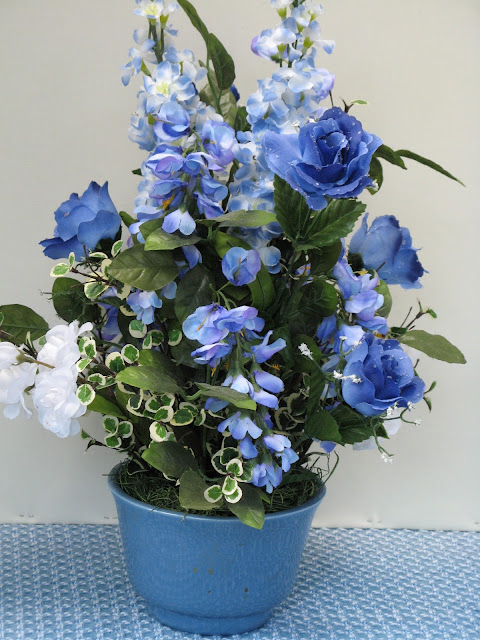
One of my favorite Spring silk florals is an arrangement I take out every year that I created about twenty years ago and is shown in the picture above. I made it using a small blue ceramic pot with blue silk floral roses, white azalea, and beautiful delphinium blue flowers. Lots of green leaves were added for fill.

It looks as good now - twenty years later - as it did when I first made it. That's the beauty of silk floral. They never deteriorate.  And, if you're careful when putting them away and storing them in the off seasons they'll last for decades.

This is where my baby sister, who is an amazing gardener, would add, "that may be true, but they can't compete with the real blue delphiniums in my garden!"  She's right about that.  There is no comparison to Mother Nature's beauty. However, silk florals never give you poison ivy - which my gardens always did.


Two years ago when I was creating needle felted art dolls I decided to create several flower fairies. It was springtime when I was working on my needle felted dolls so I shouldn't have been surprised with an urge to create something with flowers and gardens. Flower fairies were perfect. If you'd like to read my post about them please click here.


I also love creating painted birdhouses with little birds and silk floral decorations like the picture collage above. I made these back in 2002 when I was in a painted birdhouse phase and have been trying to find the time to create some how-to's on them. Hopefully, I'll be able to create those sometime soon.  

I also love adding wonderful Spring time craft tutorials that I find from all the talented crafters on the web to my Spring Craft Tutorials, Video's, Patterns and How-To's board on Pinterest.

There's over 150 pins on this board and it is filled with adorable tutorials for creating birdhouses, flowers, wreaths, bunnies, topiaries, floral decorations and so much more.   Of course, I want to make all of them, but that's not going to happen so instead I visit from time to time just for the springtime inspiration.


I hope you enjoy some of the spring seasonal crafts tutorials, video's and how-to's I have found.

If you love our Spring Craft Tutorials, Video's, Patterns and How-To's board please follow our board by clicking on the link above.