Saturday, March 31, 2007

Some Easter Bunny Jokes For The Kids!

Everyone loves cute jokes. Here's a few Easter bunny jokes for the kids:

What does a bunny use when it goes swimming?
A hare-net.


Why did the Easter egg hide?
He was a little chicken!


How can you tell which rabbits are the oldest in a group?
Just look for the gray hares!

How do you make a rabbit stew?
Make it wait for three hours!


What did the bunny want to do when he grew up?
Join the Hare Force.


How are rabbits like calculators?
They both multiply real fast!

Why can't a rabbit's nose be twelve inches long?
Because it would then be a foot!

What do you get when you cross a rabbit with a spider?
A hare net!

Why did the bunny bang his head on the piano?
He was playing by ear!

Why did the man wear a rabbit as a hat?
He didn't want to harm a hare on his head!


Why does the Easter bunny have a shiny nose?
His powder puff is on the wrong end.


What are four hundred rabbits hopping backwards?
A receding hare line!

What did the rabbit say to the carrot?
It's been nice gnawing you!


Is it true that bunnies have good eyesight?
Well you never see a bunny wearing glasses, do you?

What is the difference between a crazy bunny and a counterfeit banknote?
One is bad money and the other is a mad bunny!


Why is a bunny the luckiest animal in the world?
It has four rabbits' feet


What do you get when you cross a bunny with an onion?
A bunion!


What do you call a bunny with a large brain?
Egghead!

What did the grey rabbit say to the blue rabbit?
Cheer up!

How does the Easter Bunny say Happy Easter?
Hoppy Easter

And, my personal favorite:

What kind of jewelry do rabbits wear?
14 carrot gold!

Happy Easter.


Sunday, March 18, 2007

A Pupil, A Teacher, and The Crafting Community!

There is just something wonderful about crafting and being able to share your delight with crafting to anyone anywhere in the world. At least I think there is.

There is also something wonderful about helping another crafter and encouraging them to do what they want to do, but might be a little timid about it. After all, no one wants to look foolish. Do they?
Well, my answer to that is there is nothing that you create that you can look foolish for
Creating is creating and crafter's the world over understand this. Whether you are in India, South Africa, Australia, The United States, England, Germany, etc. crafting is crafting. Creating a doll is creating a doll. Designing a graphic is designing a graphic. Creative embroidery is creative embroidery. Crazy quilting is crazy quilting. Knitting is knitting. And, stitchery is stitchery. You get the idea.

The creation drive transcends boundaries and language. A beautiful doll created by a doll maker in India can be appreciated by any other doll maker the world over.

What sets crafter's apart no matter where they are in the world is the love of creating. The drive to not only make something, but to make it "your own."

When you make something "your own" you have set your ideas and creative imagination into the piece you have created. It becomes "beautiful" in your eyes and, hopefully, is appreciated by other crafter's who know what it is to create. So, how can you ever look foolish? My answer is you can't.
Last year a friend of mine, who makes the most wonderful dolls, wanted to try her hand at pattern making, but was a little skeptical that she could do it. Even though she had been in the craft business for 15 years she was still a little afraid and didn't want to look foolish. I, of course, encouraged her and gave her some helpful tips (at least I hope they were helpful) and told her to "GO FOR IT!" Well, she did and she hasn't stopped. She's been the energizer bunny ever since. Make that "the 2ND energizer bunny." Angie is "THE energizer bunny!"

Well, my friend has been involved with so many things since she got the confidence to do so that her creativity is in "overdrive." Along the way she's had a few questions and if I was able to help her I did.

Well, our online friendship developed to the point where she refers to me as "her teacher" and I refer to her as "my pupil." If you are a member of any of the crafting forums we belong to then you know who this is.

What is so wonderful about this story is that she has gone from 0 patterns to 18, has several websites, a crafting blog, a craft show E-Zine, and just bought a new online craft show website and a directory website. She's growing, and growing and growing. And, I couldn't be happier for her.

I know that she has helped others along the way as I have helped her. And, I hope, she will continue to do so which is what the "crafting community" worldwide is known for. We have a wonderful helping and contributing spirit amongst us that is rare and unique in today's day and age. We all help one another as we all appreciate the effort that goes into creating. And, by helping one another we all help "our crafting community" to grow. As the community grows we all benefit.

My motto is "What helps one crafter helps us all!" What could be better than that.

By the way, if you're wondering who my pupil is - it's Talena Bacon of Sew Cute Dolls & More, Sew Cute Doll Patterns, Mulberry Creek Mercantile, and Marketplace Craft Fair.

Copyright © 2007 - All Rights Reserved - Written By Linda Walsh. Linda is a doll maker and doll pattern designer.

Wednesday, March 14, 2007

The Lure Of The Leprechaun!


The lure of the leprechaun! Sounds ominous - doesn't it?

What do I mean by this? Well, what is it about leprechauns that makes people love them? What is their hidden attraction - their lure?

Is it their devilish nature? The twinkle in their eyes? Their dimples? Their rosy cheeks? Their sheer luck?

Maybe it's their tenacity? Their studiousness? Their lively spirits?

Or, the fact that they have little "pots of gold?" Hidden treasures and mischievousness?

Or, is it because they wear green outfits and live in the forest? Or is it because they are cobblers by trade? What?

So, what's the lure? Why do people far and wide love the little men in the green suits? (Almost sound like martians, doesn't it?) And, did they always wear green suits?

It's definitely something for everyone loves leprechauns, especially crafters. Of course, then again, crafters love just about anything that they can create. And, crafters love other crafters and leprechauns are shoemakers which makes them crafters after all. That's "crafters logic" for ya.

So, really, why do crafters love to create them? Is it their red hair? Is it because they are inherently lucky and we all hope some of that their luck will rub off on us? Or, is it because we can appreciate all their hard work and hard efforts to make their creations - shoes? What is it about these little men in green suits that lures us?

So, (surprise, surprise) that got me to thinking about the history of the leprechaun. If you're a reader of my Linda's Blog you had to see this coming a mile away. So, of course I had to find out - where did their legend begin?

According to Wikipedia.com - "In Irish mythology, a leprechaun (Modern Irish: leprechaun) is a type of male faerie said to inhabit the island of Ireland. They are a class of "faerie folk" associated in Irish mythology and folklore, as with all faeries, with the Tuatha Dé Danann and other quasi-historical races said to have inhabited Ireland before the arrival of the Celts."

As with many legends and folklore Irish legends are steeped in Celtic or Druid superstition and folklore that are handed down one generation to another.

Irish folklore, in particular is full of tales of fairies, leprechauns, banshees and other supernatural beings. Centuries ago it was believed that fairies lived in fairy forts which were large mounds of earth and that if you were to touch a fairy that would bring you bad luck.

Banshee's were female spirits who had long flowing hair and who wailed outside the home of someone whose was about to die. In rural Ireland to this day many people still believe in the banshee.

The most famous Irish fairy of all is, of course, the leprechaun. They are said to be aloof and unfriendly and busy themselves all day making shoes. They aren't easy to spot, but are industrious - stashing away all their money in hidden pots of gold at the end of the rainbow. According to legend, the only way to track a leprechaun is to follow the sound of a leprechaun hammering the shoes.

The image of the Leprechaun is that of a mischievous little old man who is 2' tall and a cobbler or shoemaker by trade. They are usually thought of to be rich, having buried many, many "pots of gold." According to legend, if you come across a leprechaun do not look away. If you do they will disappear. If you keep your eyes fixed on them they cannot escape or vanish. But, they are cunning and often can trick you into looking away.

In most of the folklore surrounding leprechauns they are characterized as harmless creatures who live alone or in remote locations. They like their solitude, but if engaged in conversation can be quite worldly. But, don't expect them to tell you where they've hidden their "pots of gold." They aren't likely to tell you that and will trick you before they do.

According to some legends leprechauns can be ill-mannered and cunning.

One interesting fact that surprised me was that in 1831 Samuel Lover wrote that the leprechaun wore a red coat, and Yeats in 1888 in his book entitled Fairy and Folk Tales of the Irish Peasantry describes the leprechaun as follows:

"He is something of a dandy, and dresses in a red coat with seven rows of buttons, seven buttons on each row, and wears a cocked-hat, upon whose pointed end he is wont in the north-eastern counties, according to McAnally, to spin like a top when the fit seizes him."

Now-a-days he wears a green coat or green frock and is synonymous with shamrocks and St. Patrick's Day. And all of that is synonymous with the Irish.

The Irish have celebrated St. Patricks Day for thousands of years. Surprisingly, the first St. Patrick's Day parade took place not in Ireland, but in the United States. Irish soldiers serving in the English military marched through New York City on March 17, 1762.

Over the next several decades Irish patriotism amongst American immigrants flourished and parades and "the celebrating of the green" became synonymous with Irish American pride.

Millions of Irish immigrants started pouring into to the U.S. during the Great Potato Famine of Ireland in 1845. They soon came to realize that their sheer numbers had political clout. As a result, their voting block, known as the "green machine," became an important swing vote for political hopefuls. To this day in the U.S. annual St. Patrick's Day parades and breakfasts are a must-attend event for seasoned politicians and political hopefuls. And, everything, including the food is "green" in color.

So, as with most legends and folklore the legends become history and the folklore becomes tradition. Soon it becomes hard to tell the legends and folklore from the facts. So, are the Irish lucky (i.e. the luck of the Irish) because of the leprechauns or the leprechauns lucky because they are "Irish?" We'll never know.

"The luck of the Irish" has been a saying tossed around for decades, along with images of tiny green men, green beer and, of course, the four-leaf clover. Some say that the saying "luck of the Irish" doesn't infer luck at all - but, instead, infers "bad luck!" We'll never know for sure. In any event, if you are lucky enough to be Irish or to see a "leprechaun" maybe you'll soon be finding your own "pot of gold." Maybe that even means that if you're a crafter who makes them "you will soon find your reward for all your hard work!"

For crafters, leprechauns come in all shapes, sizes, and materials, They are short, fat, skinny, tall, made of cloth, wood, ceramic, plastic, etc. They can be made out of just about anything, but for sure, they are all mischievous. Whatever it is that lures us to make them - they are a delight to make.

And, if you do make a leprechaun doll - watch out. They can be mischievous and cause quite the stir in your household.

Happy St. Patrick's Day.

Wednesday, March 07, 2007

Some Irish Blessings For You


As St. Patrick's Day approaches please remember these Irish Blessings:

May your thoughts be as glad as the shamrocks,
May your heart be as light as a song,
May each day bring you bright, happy hours,
That stay with you all the year long
---------------------------------------------
May the Irish hills caress you.
May her lakes and rivers bless you.
May the luck of the Irish enfold you.
May the blessings of Saint Patrick behold you.
---------------------------------------------
May your blessings outnumber
The Shamrocks that grow.
And may trouble avoid you
Wherever you go.
---------------------------------------------
May your pockets be heavy and your heart be light.
May good luck pursue you each morning and night.
---------------------------------------------
Wishing you a rainbow
For sunlight after showers—
Miles and miles of Irish smiles
For golden happy hours—
Shamrocks at your doorway
For luck and laughter too,
And a host of friends that never ends
Each day your whole life through!
---------------------------------------------
And, my favorite Irish blessing:

May you live a long life
Full of gladness and health,
With a pocket full of gold
As the least of you wealth.
May the dreams you hold dearest,
Be those which come true,
The kindness you spread,
Keep returning to you.


Happy St. Patrick's Day!


Friday, March 02, 2007

Who Doesn't Love Bunnies?


Who doesn't love cute, cuddly bunnies. Crafters and doll makers certainly do. When a crafter thinks of Easter or Spring they generally think bunnies and eggs. They're become a staple of Easter and Spring.
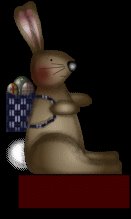
Why? Because like many other items crafters can do so many things with them. They can be Victorian, Primitive, Country, even Shabby Chic. They can be made of fur, cloth, wood, metal, just about anything. They can be colorful or bleak. They can have clothes or no clothes. They can be cuddly or firm. They can be standing, sitting, even hopping. They can be toys, dolls, knick-knacks, graphics, cartoons, candy, signs, pictures, etc. Just about anything you can imagine. The sky's the limit.

So, where did all the fascination and tradition of bunnies being associated with Easter and Spring begin. As with a lot of our traditions bunnies or really, hares have their origins in pre-Christian or pagan folklore. They served as symbols of abundant new life in the Spring. It was decided that Easter would always be the first Sunday following a full moon. So, since the moon was used to determine the date for Easter and the hare was the Egyptian symbol for the moon, hares became associated with Easter. Hares are nocturnal like the moon and carry their young for a month before giving birth, which is like the changing moon with its monthly full moon. It was also believed that the hare always kept its eyes open, watching the moon.

According to some pagan folklore, the Easter bunny was originally a large bird belonging to the goddess Eostre. To entertain her children she magically changed her favorite pet bird into a hare, which immediately laid colorful and magical eggs. So, because the Easter bunny was really a bird at heart he continued to build a straw nest and fill it with eggs.

Eggs were dyed and eaten during the Spring festivals in ancient Egypt, Greece, Persia, and Rome and were given as gifts to celebrate the coming of Spring. In all cultures the egg symbolizes the beginning of life or the universe. The early Christians didn't feel that the pagan custom of coloring eggs was harmful so they kept that pagan tradition and applied it to their own festivities. Some speculate that missionaries or Knights of the Crusades were responsible for bringing the coloring of eggs westward.

The earliest known reference to a modern Easter Bunny appears in German writings in 16th century Germany. In medieval times eggs were traditionally given at Easter to the servants. The first edible Easter bunnies were made in Germany during the early 1800's and were made of pastry and sugar.

In the 18th century, German settlers brought the Easter Bunny tradition to America. The white Easter Bunny was called "Oschter Haws" or "Osterhase" and brought gifts of chocolate candy to good children. The children believed that if they were good the "Oschter Haws" would lay colorful eggs for them in a nest the children had built, which was usually a hat or bonnet that was placed in a secluded place like the barn or the garden.

Placing the hats or bonnets in secluded places eventually lead to the Easter Hunts. On Easter morning the children of the house would join together in a search for the eggs that the Easter Bunny had hidden while they were asleep.

By the 19th century the Easter Hare became the Easter Rabbit. Plastic Easter eggs made their debut in the early 1960's with more than 1 million plastic eggs being purchased each year for Easter. American families would later change the tradition of the nest into using baskets and giving chocolate as well as money. And, today, we know how commercial all of this has become. Easter baskets are no longer just filled with candy eggs. It's amazing how a simple tradition has become such a commercial affair.

In any event, now you know why bunnies are associated with Easter and Spring. I suspect that crafters will continue with their love affair with bunnies for a long time to come. They're just so versatile. Besides, how can you not love a bunny? They're just so cute, so cuddly, so fuzzy, so warm, so....

Oh, here comes Peter Cottontail!
Hopping down the bunny trail,
Hippity hoppity, Happy Easter Day!"

Graphic courtesy of Becky at www.primsandstems.com

Thursday, March 01, 2007

Linda's Review of Jan Foulke's Guide To Dolls - A Definitive Identification and Price Guide


You may recall that I recently reviewed Jan Foulke's 15Th and 16Th edition Blue Book of Dolls & Values in an article on "The Book Review Blog."

Well, I was recently sent Jan Foulke's Guide to Dolls: A Definitive Identification & Price Guide. It's been four years since her last price guide and I have to tell you that this guide is every bit as good if not better.

Jan has been a trusted authority on antique and doll collecting for over thirty years and her latest release will again prove to be the "bible" of doll collecting.

If you are into dolls and collecting old, vintage, or even new dolls "Jan Foulke's Guide To Dolls - A Definitive Identification and Price Guide" will help you identify and learn about your dolls or dolls you are thinking of buying. It can help you appraise the dolls you already have in your collection as well as help you to determine whether or not a doll you are considering buying is fairly priced.

It also has useful information for the doll collecting enthusiast as to investing in dolls, marks to look for, quality, condition, body, clothing, total originality, age, size, availability, popularity, desirability, uniqueness, and visual appearance. It also has tips for selling a doll.

Jan Foulke's Guide To Dolls - A Definitive Identification and Price Guide is organized into two alphabetical sections: Antique & Vintage Dolls, and Modern & Collectible Dolls. In each section the dolls are listed alphabetically by doll maker, by material, and sometimes by trade name.

The values shown in Jan Foulke's Guide To Dolls - A Definitive Identification and Price Guide are retail prices for clean dolls in excellent overall condition. For the doll collecting enthusiast this book is an indispensable tool especially if you're looking for that "rare" doll find or are just starting a doll collection and looking to buy a doll of value.

St. Patrick's Day Jokes For The Kids


Here's some St. Patrick's Day jokes for the kids:

Q - Why do people wear shamrocks on St. Patrick's Day?
A - Real rocks are too heavy!


Q - When is an Irish Potato not an Irish Potato?
A - When it's a FRENCH Fry!


Q - What do you call a fake stone in Ireland?
A - A sham rock!


Q - Why do frogs like St. Patrick's Day?
A - Because they're always wearing GREEN!


Q - What is out on the lawn all summer and is Irish?
A - Paddy O'Furniture!


Q - Why did St. Patrick DRIVE all the snakes out of Ireland?
A - Because it was too far for them to CRAWL!


Q - What kind of bow can't be tied?
A - A rain bow!


Q - Why should you never iron a 4-leaf clover?
A - You never want to PRESS your luck!


Q - What do you call a clumsy Irish dance?
A - A JIG mistake!


Q - Why do so many people live in Ireland?
A - Because the capital is always DUBLIN!


Q - How can you tell an Irishman is having a good time?
A - He always DUBLIN over with laughter!


And, finally:


Knock! Knock!
Who's there?
Irish!
Irish Who?
Irish you a Happy St. Patrick's Day!


Thursday, February 08, 2007

Harry Potter Books and My Grandson


With the latest news that the 7th and final book in the wildly popular Harry Potter series entitles "Harry Potter and the Deathly Hallows" will be released July 21, 2007 I thought I'd relate a story about the series and my grandson that you might enjoy.

Several years ago I was looking for a birthday present for my grandson. I wanted the present that his Grandfather and I gave him to be one that was "THE HOTTEST ITEM" among adolescent and teenage boys at the time.

I had read that one of the hottest and coolest items among adolescents and teenage boys was "The Harry Potter" Series of books, which then had only 3 books in the series. So, I decided we'd give him the 3 hardcover books that were in the series.

Even though this was the "hottest" ticket item it was a gamble for his Grandfather and I. You see, my grandson wasn't a reader. But, I figured peer pressure would create enthusiasm for him and maybe he'd discover a love for reading.

Well, he opened his present, smiled and said thank-you, but wasn't really thrilled. We'd bombed out. At least we thought so until the following year when "Harry Potter" really took off. Then the teenage boys and adolescents couldn't get enough of Harry Potter. Harry Potter mania had set in and all of a sudden we (that is his Grandfather and I) were just the "coolest" grandparents as our Grandson already had the first three books in the series and was "the man" among all his friends.

Even our son-in-law was enthusiastic about the books and decided to start reading them to our youngest grandson for his bedtime stories. It took awhile but they got through the first 3 books and decided to buy the 4Th book in the series.

Well, not to be outdone by their younger brothers our older teenage granddaughters decide to read the series, too. So they, too read all three of the books in the set we had given their brother and then read Book 4.

After that they moved on to Book 5, then Book 6.  They all read all of those, too.

Our grandson ended up loving the books. I'd love to say that he became a reader because of it. He did and he didn't.

He has become a reader - just a reader of a different kind of book. You see - he loves the Japanese cartoon books that you read from back to front like "Inu Yasha", "Fruit Basket", "Juvenille Orion", and the "Trigun Maximum" series.

For me, the Grandmother who gives books every Christmas that's terrific. At least he's reading. Doesn't matter whether it's comics or not. He's reading. So, I just buy him the latest comic books in those series.

So, the moral of the story is that - "Just because a present isn't initially received
with the greatest of enthusiasm doesn't mean it won't be appreciated over time."

I suspect he and his brother will want the 7th and last book in the Harry Potter's series. I'll have to pre-order it for them.

I suspect "Harry Potter" mania will take over again this summer and the books may be hard to find for awhile.

I'll let you know next summer how my two grandson's liked it.


Sunday, January 28, 2007

Sometimes It Works - And, Sometimes It Doesn't!

Anyone who has ever created a doll knows that "sometimes it works - and, sometimes it doesn't!" Well, yesterday I had one of those "sometimes it doesn't work" days.

I don't know if i mentioned this, but I'm in the middle of sewing the dolls for all 150+ of my new designs.

150+????

Yes, I do like to do things in large quantities. First I design for days on end. Then I cut-out the dolls for days on end. Then I sew all the bodies and clothes for days on end. Then I put all the dolls together - which I absolutely love to do - for days on end. Then I create the e-pattern for days on end. And, finally I add the new doll pattern to my website for days on end.

Some designers do it one doll at a time. I tend to go overboard (you think!!!!) and do large quantities at a time. That's me!

In any event, I had designed a a "sunshine type Annie" on paper and thought she'd make a cute, sunny doll. Everything was going fine until it came to embroidering her face. I thought I might give her blue eyes - MISTAKE. She looked like a - I don't know - a monster of some sort. Certainly not friendly.

So, I ripped the blue eyes out, drew new eyes that I liked on paper, and changed them to match on the doll. Now they were black and, sort of, looked okay. I wasn't sure they were an improvement, but I told myself to relax and wait to see what she looked like with her hair.

Well, I had intended her hair to be spiked, but didn't like it when it came to adding it to her head. She kind of looked like a "zombie." So, I changed it to using a multi-colored angora yarn that I added to her head in a kind of "loopy" fashion.

Hair wise she kind of looks like a "Gibson" girl, except she still looks - well, not sunny. More like - a "Gibson" girl type zombie. Her eyes are better, but she'd definitely scare my grandchildren.

So, I decided to make her primitive and coffee stained her last night.

Why, primitive?

I don't know. Sometimes adding the coffee stain helps and sometimes you end up with the most beautiful coffee stained dolls. It's always a surprise with coffee-staining. You just never totally know how the doll will look until it's dried.

When I went to bed she was still drying and I haven't looked at her this morning. I'm afraid to.

Wonder what I'll find?

Zombie?

Primitive Gibson girl?

Gibson girl nightmare?

Primitive Gibson girl zombie doll?

Now that would definitely be a best seller - don't you think?

Thursday, January 25, 2007

Linda's Dolls and Craft Book Review Series - Book #5 Sewing & Sculpting Dolls


If you are familiar with me then you know that I am a cloth doll maker and doll pattern designer. You also know that I love dolls of any kind, shape, or size. It doesn't matter if they are plain, elaborately costumed, ugly (sometimes the uglier the better), made of wood, cloth or clay, or even paper. It doesn't matter if they have faces or are faceless. They can be boys, girls, animals, creatures, ghosts, goblins, witches, angels, etc. It doesn't matter to me. I just love dolls.

Well, several years ago I bought a delightful book on cloth doll making by Eloise Piper. It was for making dolls from cloth, modeling paste, and polymer clay. But, what caught my eye was that it looked like it would be a "fun" book with a "sense of humor" contained within.

The books title is Sewing and Sculpting Dolls: Easy-To-Make Dolls from Fabric, Modeling Paste, and Polymer Clay and the author is Eloise Piper. Eloise is an artist, teacher, and doll maker.

"Sewing & Sculpting" Chapter One starts with information, patterns, and examples for sewing and making the basic rag doll body. Throughout the pages are whimsical doll illustrations to delight you as you read through it. Basic doll design is followed by customizing the basic pattern, then body proportions. And, of course, all the pages have the whimsical doll illustrations.

In Chapter Two you learn about materials and processes. Here you might learn about doll making materials, tea staining, spatter painting, gessoing, painting, crackling, stain buffing, needle sculpting, sculpting with modeling paste, and sculpting with polymer clay. You also learn about additional surface embellishing techniques.

In Chapter Three you get instructions for making plain and fancy dolls using the basic doll body pattern that Eloise provides. You can make plain Amish children, play pals, fancy dolls, creating a wig, and sewing the basic wardrobe.

Chapter Four is for the intermediate doll maker and is titled "Dolls of a New Dimension." It includes intermediate cloth doll projects with sculpted modeling paste faces. It is a wonderful chapter with details and pictorials throughout.

Chapter Five is for the advanced doll maker and has advanced doll projects for cloth bodied dolls with polymer clay heads, feet, and hands. It, too, is a wonderful chapter with pictures of some of Eloise's finished dolls.

All throughout the book you are presented with whimsical drawings and caricatures. Each and every one is delightful and is what makes this book so much fun to read. For the cloth doll making enthusiast there is a lot to learn in Elosie's Sewing and Sculpting Dolls: Easy-To-Make Dolls from Fabric, Modeling Paste, and Polymer Clay book. If you're just starting out making cloth dolls or are an intermediate or advanced doll maker Elosie's "Sewing & Sculpting Dolls" is a great book to have.

Saturday, January 20, 2007

Linda's Dolls and Craft Book Review Series - Book#3 - New Complete Guide To Sewing


I was very fortunate to learn how to sew from my mother and my mother's best friend when I was 9 years old. They showed me how to use the sewing machine, explained how to read a pattern, showed me how to cut out the pieces, and explained what the various sewing terms meant, etc. I learned the basics from them - the rest I learned through trial and error. And, I have been sewing now for over 50 years.

At times I wished I had a comprehensive sewing book that would explain everything there is to know about sewing with detailed illustrations and pictorials. Well, in 1976 my mother bought one that I just loved.

So, I decided to review "The New Complete Guide to Sewing: Step-by-Step Techniques for Making Clothes and Home Accessories Updated Edition with All-New Projects and Simplicity Patterns (Reader's Digest)"from Reader's Digest.

In 1976 Reader's Digest published their first "Complete Guide To Sewing" and it became the standard reference book for beginners and sewers. It had everything but the kitchen sink in it. And, best of all it had detailed step-by-step instructions to explain everything, including the kitchen sink. I was thrilled when my mother bought her copy and I borrowed it multiple numbers of times over the years.

Well, I decided several years ago that it was time for me to have my own copy so I bought the Reader's Digest "New Complete Guide to Sewing - Step-by-Step Techniques for Making Clothes and Home Accessories."

If you want to learn how to sew then you don't need any other book but this one. It has so many detailed directions, so many illustrations, so many pictorials, so many work saving tips, and practical advice that it's hard to comprehend it all in one sitting. Plus, it also has 20 fun projects for you to try. It is a virtual smorgasbord of a sewing encyclopedia.

There are eleven chapters, which cover: Sewing Equipment and Fabrics, Cutting, Stitches and Seams, Neckline Finishes and Collars, Waistlines and Belts, Sleeves and Sleeve Finishes, Pockets, Fastenings, Tailoring, and Patchwork and Quilting.

The projects include an evening blouse, dress pants, pleated skirt, christening dress, curtains, summer dress, tailored jacket, short blouse, sheer curtains, Bermuda shorts, skirt, girl's skirt, boy's short, safari jacket, pillow cover, beach towel, lace blouse, bench cushion cover, patchwork vest, and baby blanket.

I've only had my copy for a few years but the pages show evidence of a lot of use. Even an old dog can learn new tricks and I find that every time I pick this book up to look at something that I learn something new or re-learn something I obviously had forgotten.

There's a lot to digest in this book. But, if you want one book to teach you how to sew this is the book you should have. Best of all it's a book that can be used by beginners and expert seamstresses alike.

Wednesday, January 17, 2007

Linda's Dolls and Craft Book Review Series - Book#2 - Tasha Tudor's Heirloom Crafts


I doubt there is anyone who is involved with primitive or heirloom crafts, makes primitive or heirloom crafts, or loves primitive decor who does not know who Tasha Tudor is. I certainly know who she is and just love all the children's books illustrated by her, and books written about her and her life in New Hampshire and Vermont.

So, I thought I'd tell you about one of the books about her that I just love.

The book's title is Tasha Tudor's Heirloom Crafts and the Author is Tovah Martin. Photographs are by Richard W. Brown. The book comes in hardcover with the first picture that is shown above as its' cover and in softcover with the second picture shown above as its' cover.

Just to give you a little biography on Tasha Tudor she is a world renown illustrator. She was 92 when she passed away in 2008 and her first book "Pumpkin Moonshine" was published in 1938.


I became aware of her as a child due to the beautiful children's books she illustrated including The Secret Garden, Mother Goose, and The Little Princess. Tasha raised her family in New Hampshire and then moved to Vermont 36 years ago into a home built by her son Seth using hand tools.

Previous to that she lived in New Hampshire in a 17-room brick farm house that was filled with antiques. One room of her house (which I would have loved to see) housed her antique doll collection.

Tasha is an expert at cooking, canning, candle dipping, soap making, weaving, knitting, spinning, basketry, gardening, quilting, lace making, sewing, pottery, dried florals, and doll making.

Tasha Tudor's Heirloom Crafts book is filled with beautiful pictures of Tasha and her life in Vermont. We get to read about and see pictures of the interior of her beautiful primitive house, her antique loom, her dolls, her puppets, basketry, woodworking and pottery. We also get to read about and see pictures of her gardens and her dried florals. There are chapters on dyeing wool, spinning flax, dairying, soap making, candle making, canning, cider making, and open hearth cooking. And, my favorite chapter is the one on "The World in Miniature" which includes her marionettes, toys, dolls, and her dollhouse.

If you love primitive or heirloom crafting and want to learn about primitive life in Vermont and heirloom crafting from an astonishing woman than you need look no further than Tasha Tudor's books.

Books about her and her life in New Hampshire and Vermont are a MUST READ for the primitive and heirloom crafting enthusiast. Her family currently handles her business and the Tasha Tudor website at http://www.tashatudorandfamily.com/.

I hope you enjoy browsing through Tasha Tudor's Heirloom Crafts, reading the wonderful chapters, and viewing the beautiful pictures as much as I did.