I thought it might be fun to take a look at some of the long lost Christmas celebration traditions, like mistletoe, to see when and where they started. So, let's begin with bells:
Bells - The ringing of bells originated from pagan mid-winter festivities. They believed that the cold, sunless winters made the evil spirits more powerful. One way to drive the evil spirits away was to make a lot of noise. The bells suited this purpose as you could ring a bell while at the same time you were singing or shouting above it.
Believe me, if there were evil spirits near me I'd drop the bells and go running for the hills, yelling at the top of my lungs!
Candles - The Christmas Candle is another tradition which evolved from the pagan mid-winter festivities. It was believed that light was also a way to keep evil spirits away.
Those evil spirits just won't go away, will they? It was customary in Victorian England to place lighted candles in the windows during the 12 days of Christmas as a sign to weary travelers that food and shelter could be found here. Also, it was a signal that there were no evil spirits there, or so the wanderer thought.
Holly - Holly was considered magical because of its shiny leaves and its ability to bear fruit during the winter. It was believed that in liquid syrup it would stop coughs and that when hung over one's bed would induce sweet dreams. The prickly holly is called "he" (what a surprise) and the non-prickly holly is called "she" (surprise, surprise). Tradition says that the type of holly which is first brought into the house determines who will rule the household for the coming year.
My guess would be that A LOT of non-prickly holly is the first to enter the households.
Christmas Pudding - I can't say as if I've ever had Christmas pudding. The tradition surrounding the Christmas pudding originated in the 14th century. It was actually a porridge made by boiling beef and mutton which was combined with raisins, currants, prunes, wines and spices
(sounds delicious, doesn't it?) It was made in large copper kettles and prepared several weeks before Christmas with all of the household members participating.
Each member of the household had to take their turn at stirring the stew and making a wish. By the 1600's the addition of eggs and breadcrumbs, ale and spirits (of course), improved its taste significantly. As with other Christmas traditions, Christmas pudding was banned during the Protestant Reformation, but re-established as part of the traditional Christmas feast by King George I. Tradition calls for a silver coin to be placed in the pudding along with a ring, button and thimble. Somewhat dangerous, I would think, especially for small children. It was believed that the finders of these objects in their Christmas pudding would be given the gift of wealth, be married within the year or be doomed to bachelor or spinsterhood.
First Footing - This tradition sounds a lot like Santa Claus coming to me. In any event, in some countries, first-footing takes place at the New Year. In England, it occurs on Christmas Day. The first-footer is the first person to enter the house and, according to tradition, is said to let in Christmas. In some areas, he is a professionally hired First Footer
(try putting that on your resume) to make sure that the tradition is carried out properly. He carries an evergreen twig, and comes in through the front door. He then passes through the house and exits through the rear
(sounds like a burglar to me.) According to tradition, you may give him salt or bread or some other small gift as a symbol of your hospitality. Boy, at least Santa Clause gets cookies. This poor man gets salt and bread. Also, according to tradition he has dark hair, not red and is always a male. I'm not sure what to say about that!
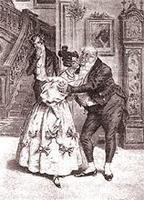
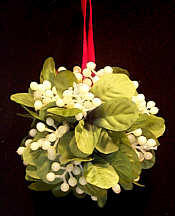
The Kissing Bough (or the Kissing Ball) - Ah! Now this seems like a nice tradition. Until the introduction of the Christmas tree, the kissing bough was the primary piece of decorative greenery in the English Christmas. It was formed in the shape of a double hoop with streamers going up to a central point and was made up of evergreen boughs, holly, ivy, apples, pears, ribbons and other ornaments along with lighted candles. A sprig of mistletoe was hung from its center (wonder what that's for?) As the name implies, any lady who accidentally
(yeah, accidentally, like we'd believe that) wanders under the kissing bough has to pay the price and allows herself to be kissed.
That's okay as long as you're kissing a prince. With my luck, I'd probably end up kissing a frog. Maybe he'd turn into a prince.
Wassail - The word wassail comes from the Anglo-Saxon term was hale, which means be well. It means to drink a toast to one's health or to express good will at a festive event. The tradition of wassailing, as with a lot of traditions, started as a pagan agricultural festival. In order to increase the yield of the apple orchards, the pagans believed that the trees needed to be toasted in the winter. So, during the twelve days of Christmas, the pagans would visit selected trees from various orchards which were either sprinkled with the wassail mixture, or had a bottle of wassail broken against their trunk. The wassail mixture consisted of mulled ale, cider or wine with sugar, roasted apples or eggs in it.
The Yule Log - After Christmas all the branches of the tree are removed and the trunk is saved to be decorated in the spring as a "May Pole." After the May Pole ceremonies are finished the decorations are removed and the trunk is cut into pieces. The largest log is then saved for the following Christmas to become the Yule Log.
The tradition of the Yule log has very deep pagan roots, as well. Surprise! Surprise! It stemmed from the Celtic, Teutons, and Druids burning the logs in their winter ceremonies in celebration of the sun. The selection of the log took on the utmost of importance and was surrounded by a ceremony. According to tradition, the largest end of the log is placed into the hearth while the rest of the tree trunk sticks out into the room. The new log is lit from the remains of the previous year's log which had been carefully stored away.
Many superstitions surround the Yule Log. It had to be ignited the first time a flame was put to it or bad luck would surely follow. Also, it had to be lit with a stick saved from the fire from the year before or the house would burn down. And, unless charcoal from the great fire was kept under the family beds for the following year (what fun), the house might be struck by lightning. Burning the log was said to bring good luck in the new year, as well as protection from fire in the home from which it is burned.
 Fruitcake -
 Ah, fruitcakes! Who doesn't love a fruitcake? I for one have never had one. Don't know why.
It just never appealed to me to eat something that was over a year old. Plus, I just never really liked the looks of them.
In any event, fruitcakes started with the Romans who needed to find a way to sustain their armies in faraway lands. Lucky Romans! The fruitcake became so popular in Europe that it was a law that fruitcake (also known as plum cake) could only be served on certain holidays and only on the most important milestones (e.g., weddings and funerals). Boy, they must have really loved their fruitcakes!
Prior to the 1700's, crusaders and hunters carried fruitcakes to sustain themselves over long periods of time away from home. Nowadays fruitcake is generally associated with Christmas. It has, however, since the 1700's been used in ceremonial celebrations of all kinds throughout Europe, including religious holidays, harvest celebrations, birthdays and weddings.
Traditionally, the top layer of the wedding cake called the "Bride's Cake", was a dark fruitcake that was removed and stored for the bridal couple to savor on their anniversaries. Oh, Boy! Lucky couple! A separate piece of fruitcake from the "Groom's cake" was wrapped in a wedding napkin, tied with a white ribbon and put at each guest's place at the table. Single women would put it under their pillow to dream of a groom of their own
(I'm not sure I'd want to sleep with fruitcake under my pillow.)
Most people today feel that fruitcake is best used as a doorstop, as a gift for someone else, or just plain thrown away. I don't even know anyone who has ever baked a fruitcake. Do you?
This tradition can definitely become a long long tradition from which it is never to return.
 Mistletoe -
 We touched on mistletoe a little in the paragraph above under the Kissing Bough. Mistletoe is a plant with white berries and has been used as a decoration in houses for thousands of years. It's also associated with many pagan rituals. Marriage ceremonies always included kissing under mistletoe. For Scandinavians, the goddess of love (Frigga) is strongly associated with mistletoe. The early church viewed this as a pagan ceremony and tried to stamp it out. In spite of this attempt the mistletoe survived as a Yuletide symbol. The practice of kissing under the mistletoe has persisted, even in song. Hey!
People just love to kiss!
 Poinsettias -
 Poinsettias were added to Christmas tradition starting in 1828. According to tradition, Joel Roberts Poinsett, then the first U.S. ambassador to Mexico, imported the plant from Mexico, which had a Christmas "miracle" story about how the plants leaves became red. The Mexicans in the eighteenth century thought the plants were symbolic of the Star of Bethlehem. Thus the Poinsettia became associated with the Christmas season. Personally, I love poinsettia's. I love to put a bunches of different colored small poinsettia plants together in a group and place several groups around the house.
So, now you know where some of these long lost Christmas traditions began. Personally, I think we can all do without the fruitcake, but that's me. Maybe you like your fruitcake. I'll take the Kissing Bough and mistletoe!
"
Oh, don't stand under the mistletoe with anyone else but me,"
" anyone else but me! Anyone else but me!"
"No, no!
"Don't stand under the mistletoe with anyone else but me,"
"anyone else but me......."
Come on. Sing along....

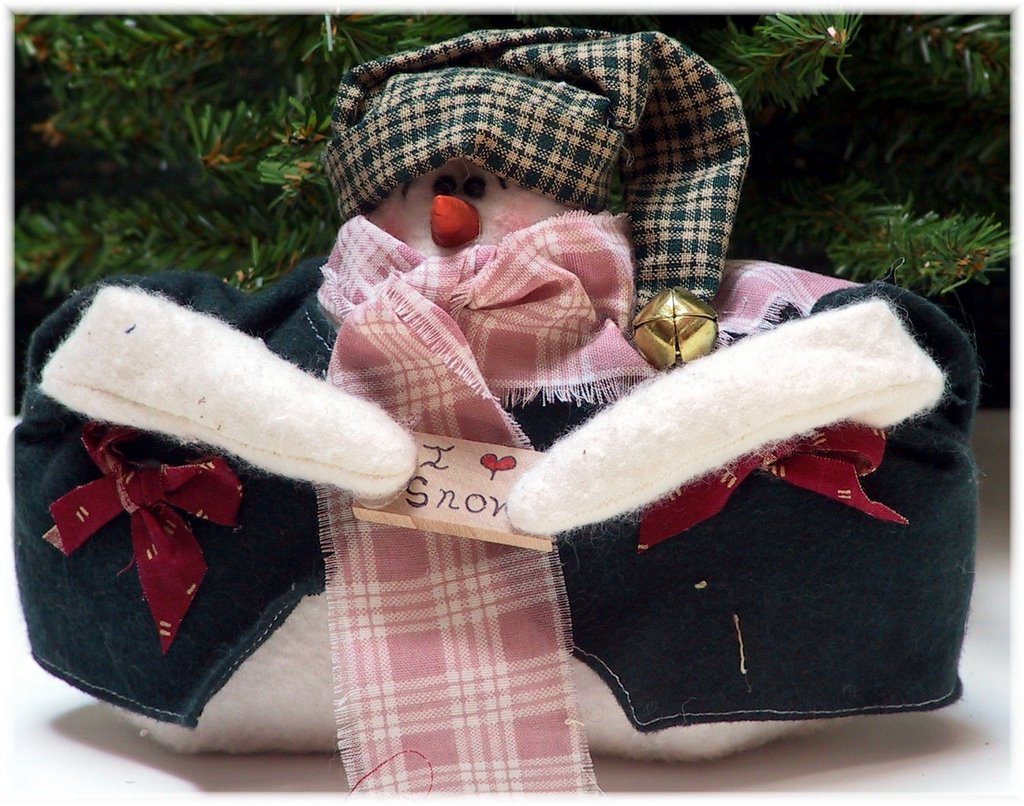 The snowguy to the left is called "Brian Snow Buddy" and is named after one of my grandsons. I named him that because he is just so adorable, as is my grandson. He's my buddy, as is my grandson. He's my pal, as is my grandson. He's so squeezable, as is my grandson. He's just so huggable, as is my grandson. He's just so lovable, as is my grandson. He's so......Stop it, Nana. You're embarrassing me. Who said that? "Brian Snow Buddy" or my grandson Brian? Both. Nah! They both love compliments.
 When I was designing this doll he kept telling me "make me like Brian." I know, you think I'm crazy that the dolls talk to me. It's bad enough that they talk to me after they're created but before too. Well, yah. Anyway, I had to make something that was as adorable, squeezable, lovable and excitable as Brian was as a little boy. Still is for that matter. He had the cutest fiery red cheeks. Talk about excitable. At Christmas time he could barely control himself. Back to the story. So, "Brian Snow Buddy" became the most adorable lovable, excitable, and squeezable snowman around. Go on, give him a squeeze or a hug. He'll love it. So will you.

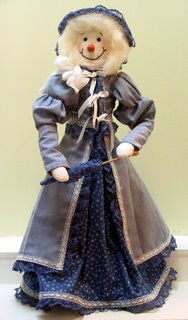 Two things today got me to thinking about "Nellie" my Victorian snowlady doll pattern. The first is that it is once again snowing outside. This is the fourth time this week. I'm beginning to think that Mother Nature is out to get us or, at the very least, inundate us with snow.
 The second is a comment from my husband. When the Christmas decorations are put away the Winter decorations, also known as snow people, make their appearance. In the front foyer of our house I have a seasonal display. Right now there is a large floral basket with all the winter blue colors and three of my snow people dolls there. The focal point of the winter display is my "Nellie" Victorian snowlady doll.
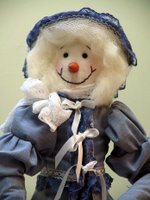
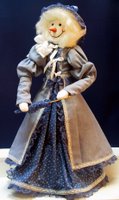 "Nellie" is a free-standing 23" tall and is wearing an 1893 Victorian Ladies Street Costume. She has a fancy double-tiered lace trimmed dress, full length double-tiered laced trimmed (inside and out) lined jacket with long puffed sleeves, fancy lace and floral decorated lined hat, lace trimmed and gathered slip, lace trimmed and gathered bloomers, lace trimmed parasol, and lace gloves. Her arms are wire-shaped and covered. Her hair is white with bangs and is fastened in a bun. Her face is partly embroidered and she has a covered Styrofoam head and cloth body supported by a wood dowel and covered wood base. Her fancy hat is tied with a lace ribbon into a bow on the side of her head.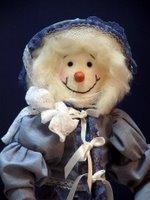
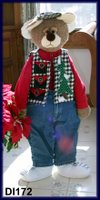 I just got a wonderful package of baby clothes from my daughter-in-law the other day that contained some baby jeans from my twin grandsons. I was THRILLED. Seems like a strange thing to be thrilled by, doesn't it? Not for me. I see old kids clothes and immediately think about the dolls I can use them on.
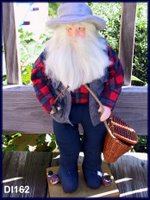 Plus, they make for such a nice memento. Every time I look at a doll that I've made that has some one of my grandchildren or relatives piece of clothing I'm instantly taken back to a memory of them. It's just such a nice way to remember loved ones and some wonderful times. My favorite, of course, is old vintage clothing especially Victorian clothes but, second to that, is baby clothes. There's just something about tiny little clothes.
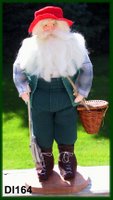 The 2nd picture DI162 (upper right) is of a old fisherman that I made based upon a pattern and kit by Courech Creations - Designs by Susan Courech. The old man is wearing light exercise pants from my grandson that I altered to look like a fisherman's wet overalls with matching boots. The flannel shirt is altered from another one of my grandsons and the vest and hat is material I cut from a brushed felt coat.
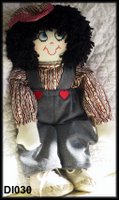 The 4th picture DI030 (to the right) is of a little boy that I made many, many years ago based upon a doll craft book I bought or was given. Unfortunately, I tore the page out of the book and don't know who the author was or who's design to credit. In any event, the shoes are my grandson's infant baby shoes and the jumper is altered sweatpants from someone.
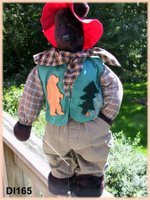 The last picture DI165 ( to the left) is of a hunting and fishing bear. He's wearing a pair of my grandsons unaltered brushed denim jeans, material from one of my brother's flannel shirts, material for his vest from one of my brother's sweatshirt, and cut up socks from someone in the family. I think his bandanna is from one of my brother-in-laws flannel shirts.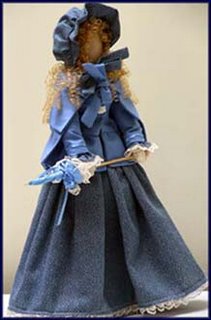






 I can remember my Mother telling me that, as I'm sure most of you can too. We all know Santa as the familiar image with his red suit, sled or sleigh, reindeers, and sacks of toys delivering packages to
 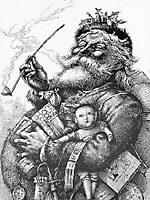 Thomas Nast helped create the kinder, more fatherly, plumper Santa as we know him today. But, Thomas Nast wasn't the only person to contribute to this legend. Clement Clarke Moore was a huge contributor as in 1822 he published his poem "A visit From St. Nicholas," bittern known as "The Night Before Christmas." His poem is the first mention of a sleigh powered by "eight tiny reindeer" and mentioning their names.
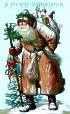 The legend of Father Christmas, however, is ancient and far more complex. Part of the legend is attributed to St. Nicholas and part to a jovial medieval figure in the "Spirit of Christmas." In Russia, Father Christmas carries a piglet under one arm. St. Nicholas is also know as Santa Claus, Father Christmas, Heilige Nikolaus, and Pere Noel.
 If you're a reader of my
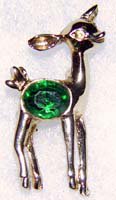
 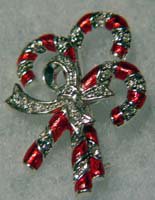 Every year I take them all out and look at them. What always amazes me is how they have changed in design from the first pin I received (the little Bambi deer above) to my latest (the candy canes above). And, believe it or not, I don't have any duplicates. Also (and I know this will be hard to believe), I don't have any "dollies." So, a heartfelt thanks to you Dad for starting this tradition and a heartfelt and sentimental thanks to my husband for continuing his pin tradition.
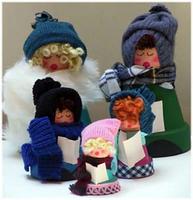 Caroling & carolers - another long lost tradition. Unfortunately, I think the lovely Christmas tradition of caroling for your neighbors has been replaced with collecting caroling dolls. Not that I think collecting any kind of doll is bad. It's just that caroling and singing holiday songs is such a lovely way to wish your neighbors a wonderful, holiday season. So, before we lose the tradition I think we need to understand why the tradition began.